弪
Character Story & Explanation
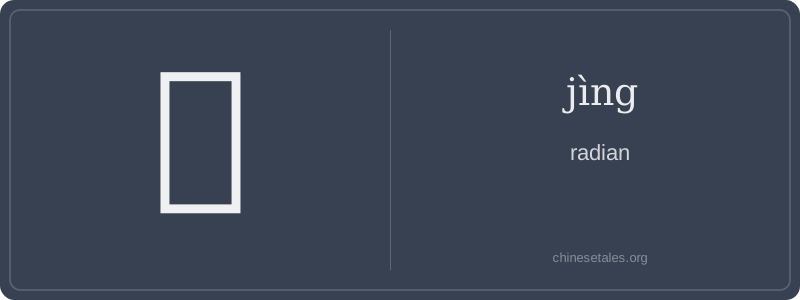
弩弓之形,初见于清末民初新造字运动: scholars needed a character for the newly adopted SI unit 'radian' and turned to 弓 (gōng), the 'bow' radical — evoking the arc of a circle, like an arrow’s flight path curving through space. The left side 弓 (3 strokes) anchors the character visually and semantically, while the right side 勁 (jìng, meaning 'strong, taut') was simplified to 丷 + 冋 — not the full 勁, but a streamlined phonetic component preserving the jìng sound. Stroke order reveals its logic: first the bow frame (three strokes), then the two dots (丷) symbolizing tension points, finally the enclosing 'frame' 冋 (jiǒng) — suggesting a bounded, measured arc. By 1932, this hybrid appeared in the *Mathematical Terminology Draft* published by China’s Ministry of Education.
The meaning never strayed: from day one, 弪 meant *only* 'radian' — no classical homonyms, no poetic extensions, no semantic drift. Unlike ancient characters repurposed over millennia, 弪 was born digital-age precise. You won’t find it in the *Shuōwén Jiězì* or Tang poetry — it’s a linguistic newborn, conceived in ink and calculus. Its visual DNA — bow + tautness — silently encodes the definition: the angle subtended when arc length equals radius, i.e., the 'taut bowstring' of a unit circle. No other Chinese character carries such laser-focused, modern-scientific intent.
Imagine you’re in a Beijing university physics lab, watching a professor draw a perfect arc on the whiteboard with a compass — not just any curve, but one where the arc length exactly equals the radius. She writes 弪 beside it and says, 'This isn’t just a unit — it’s geometry made silent and elegant.' That’s 弪 (jìng): the Chinese character for *radian*, the SI unit of plane angle. It’s ultra-specialized: you’ll almost never hear it outside math, engineering, or advanced science contexts — and never in daily conversation. Unlike common measure words like 个 or 位, 弪 stands alone as a *scientific unit character*, always following a number without measure particles (e.g., 2π 弪, never *2π 个弪*).
Grammatically, 弪 behaves like other SI units in Chinese — it’s invariant, unpluralized, and tightly bound to numerals or Greek letters. You’ll see it after π, τ, or decimals: 1.57 弪, π/2 弪. Crucially, it’s *never* used with 的 or as a noun modifier — you wouldn’t say *弪的值*; instead, it’s *弧度值* (húdù zhí) or simply *该角为…弪*. Learners often misread it as jǐng (like 景) or confuse it with 弓 (gōng, 'bow'), but its pronunciation jìng is fixed and non-negotiable — a subtle nod to its scientific precision.
Culturally, 弪 is a quiet triumph of modern Chinese lexicography: a character invented in the early 20th century specifically to translate 'radian', filling a lexical gap with surgical accuracy. It’s absent from HSK, classical texts, and even most dictionaries — yet it appears in every Chinese calculus textbook. A common mistake? Using it in spoken Mandarin — it’s strictly written/formal. And yes, many native speakers can’t pronounce it offhand! Its existence reminds us that Chinese doesn’t just borrow terms — it crafts characters with purpose, bow-shaped discipline, and mathematical grace.