弰
Character Story & Explanation
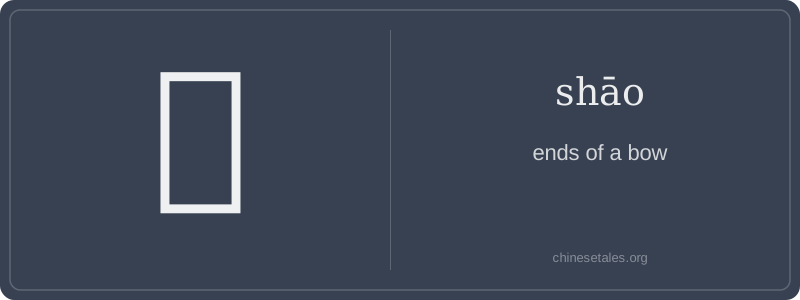
The earliest form of 弰 appears in Warring States bronze inscriptions as a stylized double-curve: two mirrored, sweeping arcs connected by a short central bar — unmistakably mimicking the flexed, tensioned tips of a composite bow. The left side evolved into the radical 弓 (gōng, 'bow'), anchoring its semantic field, while the right side, originally a simplified depiction of a tapering limb ending in a hook-like flourish, gradually standardized into 少 (shǎo, 'few'). This wasn’t phonetic borrowing per se — 少 here is a *visual shorthand* for 'diminishing to a point', echoing how bow tips narrow to near-nothingness under draw. Over centuries, clerical script smoothed the curves, and regular script fixed the balance: 弓 on the left, 少 on the right — a perfect visual haiku of elasticity and precision.
By the Han dynasty, 弰 was already a technical term in military treatises like the *Six Secret Teachings*, specifying where sinew-wrapping or horn-lamination ended on the bow stave. In Du Fu’s poem 'The War Chariots', he writes of '弓弰未暖' (gōng shāo wèi nuǎn) — 'the bow tips not yet warmed by the hand', implying haste and unreadiness before battle. Crucially, 弰 never extended to other objects — unlike 尾 or 端, it resisted semantic drift. Its form remains a silent testament to ancient Chinese metallurgy and archery craftsmanship: every stroke is calibrated, like the bow itself.
Think of 弰 (shāo) as the 'arrowhead' of the bow — not where the arrow sits, but where the bow itself tapers to its finest, most delicate points: the two curved tips at either end. In English, we’d say 'the limbs of a bow' or 'bow tips', but 弰 is far more poetic and precise — it’s exclusively anatomical, never metaphorical, and almost never used in modern spoken Chinese. You won’t hear it in daily conversation; it lives in classical texts, archery manuals, and poetic descriptions of ancient warfare — like calling the 'tines of a fork' instead of just 'prongs'. Its feel is elegant, technical, and faintly archaic, like finding the word 'quiver' in a Shakespearean stage direction.
Grammatically, 弰 functions only as a noun — always preceded by measure words like 一 (yī) or classifiers such as 对 (duì, 'a pair') — because a bow has two symmetrical ends. You’ll see it in phrases like 弰端 (shāo duān, 'bow tip') or 弰角 (shāo jiǎo, 'bow corner'), but never alone as a verb or adjective. Learners often mistakenly treat it like a general 'end' character (like 尾 wěi or 端 duān), but 弰 *only* belongs to bows — using it for 'ends of a road' or 'ends of a rope' is linguistically jarring, like saying 'the bow-tip of my coffee cup'.
Culturally, 弰 evokes China’s deep reverence for archery as both martial skill and Confucian virtue — one of the Six Arts. It appears in texts like the *Zuo Zhuan* and Tang poetry, where bow imagery symbolizes precision, restraint, and readiness. A common mistake? Assuming it’s related to 梢 (shāo, 'treetop tip') due to identical pronunciation — but they share no etymological root, and 梢 refers to vertical extremities (tree branches, hair ends), while 弰 is strictly horizontal, curvilinear, and weapon-specific. This character doesn’t bend — it *bows*.