弮
Character Story & Explanation
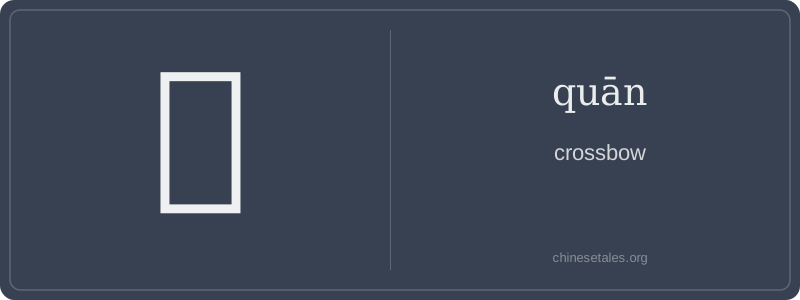
The earliest form of 弮 appears in late Warring States bamboo slips as a clear composite: left side 弓 (a stylized bow with string), right side 卷 — originally drawn as a hand twisting a rope around a drum-like frame, symbolizing the winding action required to cock a crossbow. Over centuries, the rope-and-drum evolved into the simplified 卷 we see today, while the 弓 radical retained its arching shape. By the Han dynasty, the character stabilized into its current 9-stroke form — every stroke deliberate: three for the 弓 radical (top curve, middle string, bottom brace), six for the compact, coiled energy of 卷.
This character wasn’t born in poetry — it was forged on battlefields. Mencius (3A:2) famously contrasts benevolent rule with coercive power, using 弮 as shorthand for lethal, impersonal force: '以力假仁者霸…以德行仁者王' — where 弮 implicitly underpins the 'force' (力) that tyrants misuse. Unlike 弓, which appears in idioms about harmony (如‘左右开弓’), 弮 appears only where mechanical precision, state power, or martial rigor are central — a silent witness to China’s earliest engineering revolution.
Think of 弮 not as a generic 'bow' but as the ancient Chinese military’s precision-engineered weapon: the crossbow — a game-changer in Warring States warfare. Its radical 弓 (gōng, 'bow') immediately signals its weapon family, while the right-hand component 卷 (juǎn, 'to roll up; curl') isn’t just decorative — it evokes the coiled tension of the crossbow’s prod (the bow part) and the winding mechanism used to draw the string. This isn’t a poetic or abstract term; 弮 is technical, historical, and almost exclusively literary or classical — you’ll rarely hear it in spoken Mandarin today.
Grammatically, 弮 functions as a noun only — never a verb — and almost always appears in compound words (like 弮弩 or 弮机) or classical phrases. Learners sometimes misread it as quān (like 圈) due to the 'quān' pronunciation, but it has no connection to 'circle' — that’s a classic sound-alike trap. It also never means 'archery' broadly; for that, use 射箭 (shèjiàn). Using 弮 alone in modern speech (e.g., 'I practice 弮') would sound like quoting Sun Tzu at a coffee shop — historically accurate, socially jarring.
Culturally, 弮 carries the weight of China’s early technological edge: Han dynasty crossbows could fire bolts over 200 meters with trigger mechanisms so sophisticated they baffled European engineers until the Renaissance. Mistaking 弮 for 弓 (a simple bow) erases this innovation — one is a hand-drawn weapon; the other, a mechanical force multiplier. And yes, it’s absent from HSK because modern learners don’t need to discuss bronze-age artillery — unless, of course, you’re translating the Mencius or writing historical fiction.