弭
Character Story & Explanation
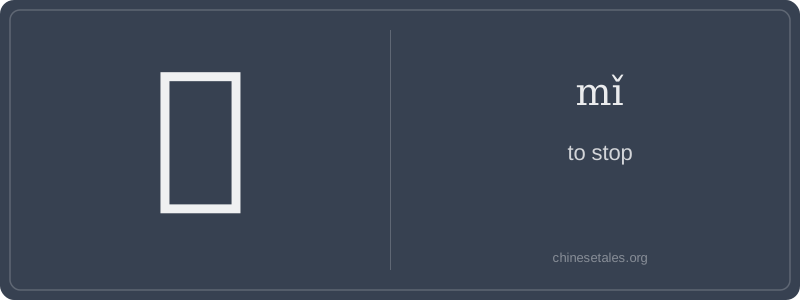
The earliest form of 弭 appears on Western Zhou bronze inscriptions as a pictograph combining 弓 (bow) and an element resembling 米 (rice) — but that’s misleading. In fact, the right side evolved from 矢 (shǐ, 'arrow'), stylized over centuries into 米-like strokes. So the original character depicted a bow *with its string slackened and arrows withdrawn* — a powerful visual metaphor for disarmament and cessation of hostilities. The nine strokes we write today preserve this logic: the left 弓 radical anchors the martial context, while the right side (originally 矢 → later simplified and fused) signals the removal of offensive capability.
This imagery resonated deeply in early Chinese statecraft. In the *Zuo Zhuan*, Duke Xi of Lu ‘弭兵’ (mǐ bīng, 'quell the armies') — not by winning a war, but by convening a peace summit where rival states laid down arms. Over time, 弭 expanded metaphorically: to quell slander (弭谤), suppress panic (弭慌), or even pacify one’s own turbulent heart (弭心). Its visual DNA — bow + de-armed arrow — never faded: every time you write those nine strokes, you’re redrawing an ancient disarmament treaty.
At its heart, 弭 (mǐ) isn’t just ‘to stop’ — it’s the quiet, deliberate cessation of something dangerous or disruptive: a rebellion, a war, a plague, or even a surge of emotion. It carries gravity and intentionality, like a general lowering his banner to declare peace after battle. You’ll almost never hear it in casual speech; it lives in formal writing, classical allusions, and solemn declarations — think newspaper editorials on conflict resolution or historical novels describing imperial edicts.
Grammatically, 弭 is almost always a transitive verb that takes a direct object (what is being stopped), and it often appears in compound verbs like 弭患 (mǐ huàn, 'avert a danger') or in literary passive constructions like '祸患已弭' (‘the calamity has been quelled’). Learners mistakenly try to use it like 停止 (tíngzhǐ) or 结束 (jiéshù), but 弭 implies not just termination, but *pacification* — neutralizing the root threat, not just pausing the action.
Culturally, 弭 reflects the Confucian ideal of restoring harmony (和, hé) through authoritative yet benevolent intervention. It’s never used for trivial stops — you wouldn’t 弭 your coffee break. And crucially, it’s nearly always written, never spoken aloud in daily life. Mistaking it for common stop-verbs leads to comically overblown sentences — imagine texting your friend '我已弭焦虑' ('I have quelled my anxiety') instead of '我放松了' ('I relaxed'). That’s not wrong grammar — it’s linguistic overkill with imperial undertones.