弩
Character Story & Explanation
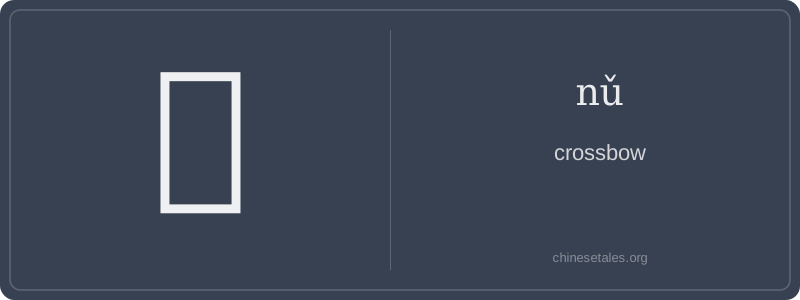
The earliest form of 弩 appears in Warring States bronze inscriptions — not as a full pictograph, but as a composite: the radical 弓 (bow) on the left, paired with 奴 (nú, ‘servant’ or ‘captive’) on the right. But this isn’t about subjugation — it’s brilliant phonetic borrowing. ‘奴’ was chosen for its sound (nú → nǔ, tone shift aside) and its visual weight: those two horizontal strokes in 奴 mimic the crossbow’s stock and trigger mechanism. Over time, the top of 奴 simplified into two short horizontals, while the lower part solidified into the ‘女’-like base — giving us today’s clean, compact 8-stroke form: 弓 + two short lines + 女 (but stylized, not literal).
In the *Zuo Zhuan* and *Records of the Grand Historian*, 弩 symbolizes strategic superiority — Qin troops carried repeating crossbows capable of firing multiple bolts, turning infantry into ranged artillery. The character’s structure reflects this: 弓 provides the projectile energy, while the ‘奴’-derived right side embodies the mechanical advantage — the servant *of the archer*, doing the heavy holding and releasing. Even in Tang poetry, 弩 evokes quiet lethality: ‘万弩齐发’ (wàn nǔ qí fā) — ‘ten thousand crossbows fire at once’ — conjures disciplined silence before devastating sound.
弩 (nǔ) isn’t just ‘crossbow’ — it’s a weapon of precision, patience, and power. Unlike the fluid arc of a bow (弓 gōng), the crossbow demands mechanical tension, a deliberate release, and a stillness that feels almost architectural. That’s why 弩 carries a subtle sense of controlled force in classical texts — it’s never wielded impulsively; it’s *loaded*, *aimed*, *fired*. You’ll rarely see it in modern spoken Mandarin (hence its absence from HSK), but when it appears, it’s often in historical narratives, idioms like ‘强弩之末’ (qiáng nǔ zhī mò — ‘the last gasp of a powerful crossbow’), or poetic metaphors for fading strength.
Grammatically, 弩 functions as a noun — always countable, usually with measure words like 张 (zhāng, for flat, sheet-like objects) or 架 (jià, for machines). You’d say 一张弩 (yī zhāng nǔ), not 一个弩. It doesn’t verbify easily — unlike ‘shoot’ in English, you don’t ‘nǔ’ something; you use verbs like 发射 (fāshè) or 射出 (shèchū) *with* 弩 as the object: 他用弩射中了靶心 (Tā yòng nǔ shè zhòng le bǎxīn).
Learners often misread 弩 as ‘nú’ (like 奴) because of the ‘奴’ component — but the tone is third, not second! And crucially: 弩 is *never* used for modern firearms (that’s 枪 qiāng); confusing them erases millennia of technological distinction. Also, don’t confuse it with 弓 (gōng) — the bow is flexible and hand-drawn; the crossbow is rigid, lever-activated, and historically revolutionized warfare in Warring States China.