弨
Character Story & Explanation
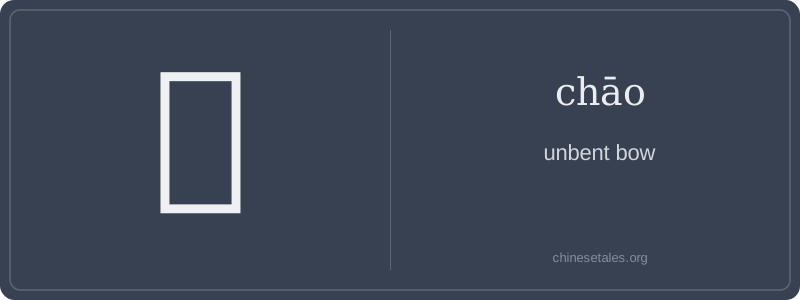
The earliest form of 弨 appears on Warring States bamboo slips as a stylized pictograph: two parallel horizontal lines (representing the bow’s elastic limbs) bracketing a vertical line (the bowstave), with a small curved stroke near the top — symbolizing the taut string stretched *across* the uncurved frame. Over time, the oracle bone simplicity hardened into bronze script, then seal script, where the ‘弓’ (bow) radical anchored the left side, and the right-hand component ‘召’ (zhào) emerged not for sound (though it approximates chāo), but as a semantic amplifier — ‘to summon’, suggesting the bow is *ready to be summoned into action*. By the Han dynasty, the modern shape stabilized: 弓 + 召, preserving both the object and its state of poised readiness.
This meaning held remarkably steady across millennia. In the Rites of Zhou, 弨 appears in inventories of royal armories, distinguishing ceremonial bows kept perpetually strung but undrawn. Later, poets like Du Fu used it metaphorically — ‘弓弨如月未盈’ (the unbent bow resembles the crescent moon, not yet full) — linking physical form to cosmic potential. Visually, the character’s balance is telling: the rigid ‘弓’ on the left contrasts with the dynamic, upward-reaching ‘召’ on the right — a perfect visual pun for tension held in stillness. It’s not about slack; it’s about coiled intent.
At first glance, 弨 (chāo) feels like a linguistic fossil — it means 'unbent bow', a term so specific and archaic that even most native speakers have never uttered it aloud. Unlike common characters tied to daily life, 弨 evokes the tactile reality of ancient warfare and ritual: not the drawn, lethal weapon, but the bow at rest — still strung, still taut with latent power, waiting for intention. This isn’t just physical description; it’s a quietly philosophical snapshot of *potential energy* in Chinese thought — where readiness matters as much as action, and stillness is never inert.
Grammatically, 弨 is almost exclusively a noun and appears only in classical or literary contexts — never in spoken Mandarin or modern compound verbs. You won’t find it in ‘I shoot an arrow’ (我射箭), but you might encounter it in a Tang dynasty poem describing ceremonial archery gear: ‘弓弨而弦直’ (the bow is unbent yet the string remains taut). Crucially, it’s *not* used attributively like ‘unbent’ in English — you can’t say ‘弨弓’ (that would be redundant); instead, 弨 stands alone as a technical term for the state itself. Learners often misread it as a verb or force it into modern syntax, but 弨 resists adaptation — it’s a lexical relic, not a living word.
Culturally, 弨 reveals how precisely Chinese vocabulary once mapped material reality: every stage of bow use had its own character — 弩 (crossbow), 弛 (loosened bowstring), 张 (to draw/extend), and 弨 (unbent but strung). Today, this precision survives only in dictionaries and calligraphy studios. A common mistake? Confusing it with 弛 (chí, 'to relax, loosen') — visually similar, but semantically opposite: 弛 means the string is *detached*, while 弨 means it’s *tightly strung but unbent*. That tiny distinction carries centuries of martial craftsmanship.