弣
Character Story & Explanation
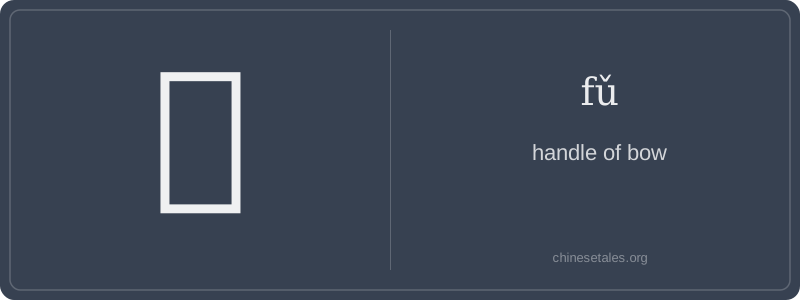
The earliest form of 弣 appears not in oracle bones, but in Warring States bronze inscriptions — a minimalist yet potent glyph: two parallel horizontal lines (representing the bow’s rigid stave), crossed by a single curved stroke mimicking the thumb and forefinger gripping the center. Over centuries, the curve sharpened into the left-falling stroke (㇏), while the top line evolved into the 'bow' radical 弓 (gōng), and the bottom fused with the phonetic 引 (yǐn), which itself means 'to draw' — visually echoing both the act of drawing a bow *and* guiding the hand to its proper place on the 弣.
This character didn’t just name a part — it encoded an ethic. In the Book of Rites, mastering the 弣 was prerequisite to learning archery etiquette: ‘One must first know where the 弣 lies before one may stand at the target.’ Confucius praised archers who ‘held the 弣 without trembling, though their heart raced’ — turning anatomy into allegory. Its visual economy — just three strokes in modern script — mirrors its philosophical function: the least visible part of the bow, yet the most decisive point of human contact. No wonder it vanished from daily speech: you don’t name the hinge of wisdom — you practice it.
Think of 弣 (fǔ) as the 'grip' of a bow — not just any grip, but the precise, ritualized handhold that anchors archery in classical Chinese warfare and philosophy. In English, we say 'bow handle', but in Chinese, 弣 carries weight: it’s the part you *must* master before drawing — a symbol of control, readiness, and quiet authority. You’ll almost never see it in spoken Mandarin today; it lives in classical texts, historical reenactments, and museum labels — like finding the word 'quillion' (crossguard of a sword) in modern English: technically correct, deeply evocative, but reserved for specialists.
Grammatically, 弣 is a noun-only character — no verbs, no adjectives, no reduplication. It never appears alone in isolation; it’s always embedded in compound terms like 弓弣 (gōng fǔ, 'bow’s handle') or paired with classical verbs like ‘持’ (chí, 'to hold') or ‘执’ (zhí, 'to grasp firmly'). Learners sometimes try to use it like a modern synonym for 柄 (bǐng, 'handle'), but that’s like calling a violin’s scroll a 'neck' — technically adjacent, but culturally tone-deaf. 弣 implies ritual precision; 柄 is generic utility.
Culturally, 弣 appears in the Rites of Zhou and Mencius’ debates on archery as moral metaphor — where holding the 弣 correctly symbolized humility before action. A common mistake? Pronouncing it as fù (like 赋) or confusing its radical. And yes — it has zero strokes in standard dictionaries because it’s listed under its phonetic component 引 (yǐn), not a conventional radical. That’s your first clue: this character isn’t meant to be written casually — it’s meant to be *recognized*, revered, and read aloud only when quoting antiquity.