弢
Character Story & Explanation
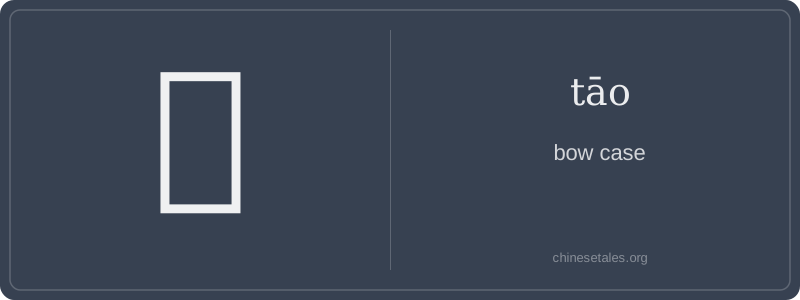
The earliest form of 弢 appears on Warring States bamboo slips as a complex ideograph: a bow (弓) enclosed within a container-like frame (often resembling 口 or 冂), sometimes with added strokes suggesting lacing or leather binding. Over centuries, the outer enclosure simplified into the top component 亠 + 冖 (a ‘covering’ radical), while the inner bow morphed into the bottom part + 口 — eventually standardizing into today’s structure: 亠 冖 勹 口. Notice how the entire character visually wraps around its core — like a case enfolding its contents.
This visual wrapping directly shaped its semantic evolution: from literal bow case → metaphorical ‘concealment’ → abstract ‘restraint’. In the Zuo Zhuan, 弢 appears in the phrase ‘弢而藏之’ (tāo ér cáng zhī): ‘sheath it and hide it’ — referring not just to weapons, but to wise suppression of ambition. The character’s very shape became a philosophical shorthand: what is covered is not gone, but held in potent reserve — a concept echoed later in Daoist ideas of wu wei (effortless action). Even its rare modern use in names (e.g., scholar Zhang Tāo) subtly invokes this aura of cultivated stillness.
Think of 弢 (tāo) as the ancient Chinese equivalent of a custom-fitted violin case — not just storage, but a ritual object that honors the weapon it holds. Its core meaning is 'bow case', but in classical texts, it evokes restraint, concealment, and dignified readiness: like keeping a sword sheathed not out of fear, but out of wisdom. It’s never used in everyday speech or modern Mandarin — you’ll only encounter it in classical poetry, historical novels, or scholarly discussions of ancient warfare.
Grammatically, 弢 functions almost exclusively as a noun, often appearing in compound words (like 韔弢) or poetic parallelism with other archaic terms for quivers and scabbards. You won’t say ‘I bought a 弢’ — instead, you might read ‘弓弢俱备’ (gōng tāo jù bèi), meaning ‘bow and case both prepared’, where 弢 stands in elegant symmetry with 弓. It never takes aspect markers (了, 过) or modifiers like 很 or 非常 — its power lies in its austerity.
Culturally, 弢 carries quiet gravitas: it appears in the Book of Rites as a symbol of civil virtue — the bow is martial, but the case signifies control and cultivation. Learners often misread it as a variant of 套 (tào, ‘cover, set’) due to the similar sound and meaning — but 套 is living, versatile, and colloquial; 弢 is fossilized, ceremonial, and silent in spoken Mandarin. Confusing them is like using ‘yeoman’ instead of ‘worker’ — technically plausible, but instantly marks you as quoting Shakespeare at a coffee shop.