弝
Character Story & Explanation
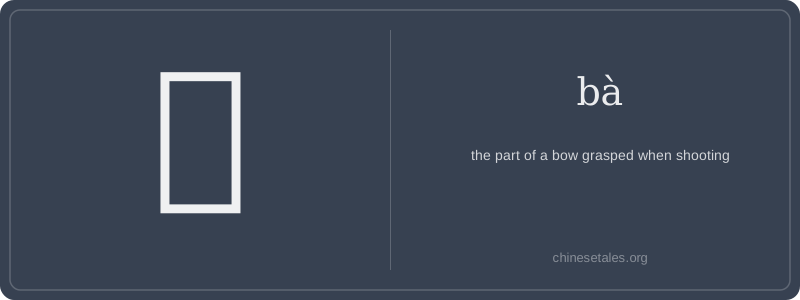
The earliest form of 弝 appears in bronze inscriptions of the Zhou dynasty (c. 1000 BCE) as a stylized pictograph: a vertical line (representing the bow stave) crossed by two short horizontal strokes near the middle — clearly depicting the hand-grip zone. Over centuries, the top stroke evolved into the ‘bow’ radical 弓 (gōng), while the lower part solidified into 巴 (bā), which originally depicted a snake’s coiled body but here served phonetically. By the Han dynasty, the character had settled into its current shape: 弓 + 巴 — visually merging the tool (bow) and the sound clue (bā → bà).
This evolution wasn’t arbitrary: 巴 was chosen not just for sound, but because its shape — curved, clinging, adhesive — subtly echoed the way a hand wraps *around* the bow’s grip. In classical literature, 弝 appears in the Zuo Zhuan describing Duke Ling of Qi’s archery contest, and in the Rites of Zhou, where proper placement of fingers on the 弝 determined ritual correctness. Even today, traditional archery masters in Taiwan and mainland China still refer to the grip zone as 弐弝 — preserving a 2,500-year-old linguistic fingerprint of embodied skill.
Think of 弝 (bà) as the 'handshake point' of an ancient Chinese bow — not the string, not the arrow, but the precise spot where the archer’s palm meets wood and power. It’s a deeply tactile, almost sacred term: in classical texts, grasping the 弝 wasn’t just functional; it signaled readiness, discipline, and alignment between body and weapon. You’ll never see it in daily conversation (it’s vanished from modern spoken Mandarin), but it lives on in historical novels, martial arts treatises, and poetic descriptions of archery — always evoking elegance, control, and ritual precision.
Grammatically, 弝 is strictly a noun — never a verb or adjective — and almost always appears after a modifier like 弓 (gōng, bow) or in compound terms like 弓弝. It rarely stands alone; you’d say 弓弝 (gōng bà), not just 弝. Learners sometimes mistakenly use it like a generic ‘handle’ (e.g., for a door or cup), but that’s wrong — 弝 belongs *only* to bows. If you try to call a teacup’s handle 弝, a scholar would gently correct you with a raised eyebrow and a quote from the Book of Rites.
Culturally, 弝 carries the quiet weight of Confucian martial virtue: archery was one of the Six Arts, and how you held the 弝 reflected your moral posture. A shaky grip meant inner disorder; a steady, centered grasp mirrored cultivated virtue. Modern learners often misread its radical or mispronounce it as ‘bā’ (like 八), but remember: it’s bà — low falling tone — echoing the firm, grounded pressure of the archer’s palm.