弓
Character Story & Explanation
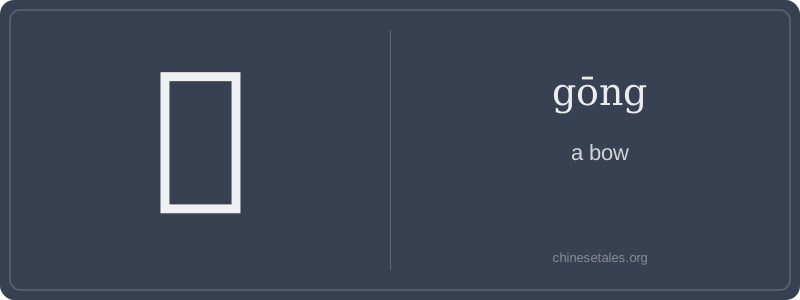
The earliest oracle bone script for 弓 looked unmistakably like a drawn bow: a smooth, taut arc with short horizontal lines at each end representing the bowstring’s nocks — sometimes even with a faint diagonal stroke across the center, suggesting the string under tension. Over centuries, the outer curves hardened into clean, angular strokes, and the string line simplified until only the elegant, self-contained three-stroke form remained: a leftward curve (㇇), a downward curve (㇈), and a final rightward hook (㇏) — like a bow releasing energy into stillness.
This wasn’t just a tool — it was a symbol of authority and cosmic order. In the *Zuo Zhuan*, rulers bestowed ceremonial bows to enfeoff vassals; in the *Book of Rites*, archery rituals embodied harmony between body, mind, and moral intent. Even today, the radical 弓 appears in characters like 张 (zhāng, ‘to stretch/open’) and 弹 (tán, ‘to bounce/弹’), preserving the bow’s core idea: potential energy held in graceful curvature — a visual metaphor for readiness without aggression.
Think of 弓 (gōng) as the Chinese equivalent of the letter 'B' in English — not because it sounds like 'bee', but because its shape is literally a bow: two curved arms holding taut tension, just like the letter B’s two rounded lobes connected by a central line. In Chinese, 弓 isn’t just ‘a bow’ as in archery; it’s a living radical and conceptual anchor — appearing in characters for ‘stretch’, ‘bend’, ‘arch’, and even ‘bow’ as in bowing (though that’s a different character, 鞠). It feels ancient and visceral, like touching carved wood and sinew.
Grammatically, 弓 rarely stands alone in modern speech (hence its absence from HSK), but it’s indispensable in compounds and classical allusions. You won’t say *‘wǒ yǒu yī gōng’* (‘I have a bow’) in daily conversation — but you’ll see it in phrases like 拉弓 (lā gōng, ‘to draw a bow’) or 弓箭手 (gōng jiàn shǒu, ‘archer’). Learners often mistakenly treat it as a verb root — it’s not; it’s almost always a noun or part of a compound noun.
Culturally, 弓 evokes martial virtue, precision, and restraint — Confucius praised archery as a ritual of self-cultivation, where missing the target revealed flaws in one’s heart, not just aim. A common mistake? Confusing 弓 with 工 (gōng, ‘work’) or 引 (yǐn, ‘to lead’) — their shapes are deceptively similar at a glance, but 弓’s three strokes form a single, unbroken arc of intention. Miss that curve, and you’ve missed the spirit of the bow itself.