弑
Character Story & Explanation
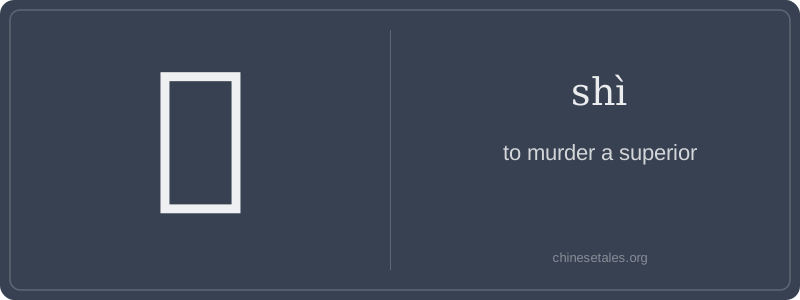
The earliest form of 弑 appears in late Warring States bronze inscriptions as a compound pictograph: the left side showed a bent bow (弋 yì, the radical), symbolizing restraint or control, while the right side depicted a hand holding a sharp blade (modern 日 evolved from an earlier ‘knife + flesh’ component). Over centuries, the knife element simplified into the current ‘shì’ phonetic (similar to 式), and the bow radical stabilized into 弋—evoking both precision and violation of boundaries. Crucially, the original glyph included a dot or stroke near the ‘hand’, suggesting intentional, premeditated action—not accidental death.
This visual logic shaped its meaning: 弑 wasn’t about violence per se, but about *breaking hierarchy*. In the *Zuo Zhuan*, it’s used exclusively for regicides like Duke Zhuang of Qi’s murder by his own ministers (‘齐人弑其君’)—never for battlefield deaths. By the Han dynasty, commentators like Zheng Xuan explicitly defined 弒 as ‘killing one’s sovereign or father with intent’. The character’s very structure—bow (restraint) + weapon (violation)—mirrors the Confucian paradox: the tool of order becomes the instrument of its collapse.
Imagine a tense scene in the Warring States period: a disgraced minister, sleeves rolled, stands over his fallen lord—not in battle, but in cold, deliberate betrayal. This isn’t just killing; it’s *shì*: murdering someone you’re morally or hierarchically bound to obey—your ruler, parent, or teacher. That’s why 弑 carries visceral weight in Classical Chinese—it’s never neutral, never casual. You’d never say ‘he *shì*-ed the thief’; the character only applies when the victim occupies a superior position in the Confucian order (君、父、师). It’s a lexical landmine: use it wrong, and you imply treason or filial horror.
Grammatically, 弑 is almost always a transitive verb, used without aspect particles like 了 or 过 in classical texts—but in modern academic writing, it appears in passive constructions like ‘被弑’ (bèi shì, ‘was murdered by a subordinate’) or nominalized forms like ‘弑君者’ (shì jūn zhě, ‘regicide’). Learners often mistakenly substitute 杀 (shā, ‘to kill’)—but that’s like swapping ‘assassinate’ with ‘kill’ and losing all political gravity. Also, 弑 never takes objects marked by 把 or 被 in colloquial speech—it’s reserved for historical, literary, or moral discourse.
Culturally, 弒 embodies the ‘five cardinal relationships’ (五伦) of Confucian ethics: violating them wasn’t just illegal—it was cosmologically disruptive. That’s why even today, historians use 弑 to signal moral condemnation, not mere description. A common mistake? Pronouncing it as sì (like 四) instead of shì—this slips past tone-checkers but changes meaning entirely (sì means ‘four’ or ‘dead’ in archaic usage). Remember: the ‘sh-’ sound whispers ‘shhh—this is treason.’