弎
Character Story & Explanation
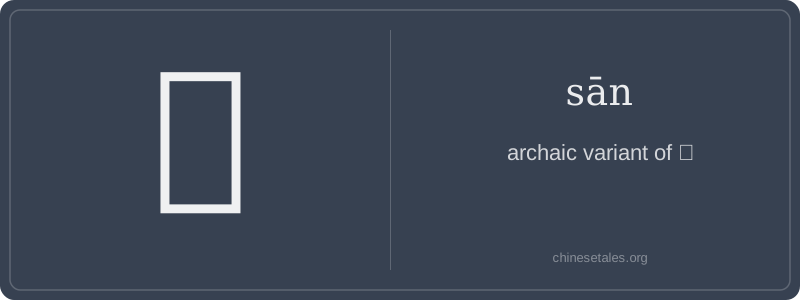
Oracle bone script had no 弎 — it emerged later in Western Zhou bronze inscriptions as a compact, ritual shorthand for 參. Early forms show three parallel vertical strokes (like 三) crossed by a gentle curve — evoking arms raised in ceremonial gesture, not digits. Over centuries, clerical script streamlined it: the top fused into a single ‘person-like’ headstroke, the middle became a slanted ‘entering’ line (入), and the bottom resolved into three delicate, flowing ‘ornamental’ strokes (彡) — mirroring the starry ‘three’ in 參, which originally depicted gazing at the Three Stars asterism in Orion’s Belt.
This evolution wasn’t about simplification — it was about intensifying meaning. In the *Book of Rites*, 參 (and thus 弎) described the act of ‘thrice bowing’ during ancestral rites: one bow for heaven, one for earth, one for ancestors. The three strokes weren’t numerals — they were ritual repetitions. By Han times, 弎 had faded from daily use, preserved only in bronze dedications and lacquerware inscriptions where space was scarce and solemnity paramount. Its shape is less ‘three things’ and more ‘threefold devotion made visible’.
Let’s cut through the confusion first: 弎 is not the everyday ‘three’ — that’s 三 (sān). Instead, 弎 is a rare, archaic variant of 參 (shēn or cān), meaning ‘to participate’, ‘to consult’, or ‘to observe closely’. Visually, it’s a stylized, highly condensed form: the top resembles a simplified ‘人’ (rén, person), and the bottom echoes the ‘彡’ (shān, decorative strokes) seen in 參 — together suggesting ‘a person engaged in careful observation or ritual involvement’. It’s like seeing a scholar bowing deeply while studying the stars — every stroke carries ceremonial weight.
Grammatically, 弎 appears almost exclusively in pre-Qin bronze inscriptions and classical texts like the *Zuo Zhuan*, where it functions as a verb meaning ‘to join in’ or ‘to take part ceremonially’. You’ll never use it in modern speech or writing — even most native speakers have never seen it outside a museum label. If you try to substitute 弎 for 三 in ‘three apples’, you’ll get blank stares or polite corrections. It’s not a number here — it’s a fossilized action verb hiding in plain sight.
Culturally, 弎 reveals how Chinese characters preserve ancient ritual grammar: its form encodes participatory reverence — not counting, but *communing*. Learners often misread it as a variant of 三 due to superficial similarity, missing the radical shift from quantity to agency. Bonus nuance: in financial contexts, 叁 (the same pronunciation sān) is the formal, anti-fraud numeral for ‘three’ — but that’s a completely different character with different origins and no relation to 弎 beyond homophony. Don’t conflate them!