弍
Character Story & Explanation
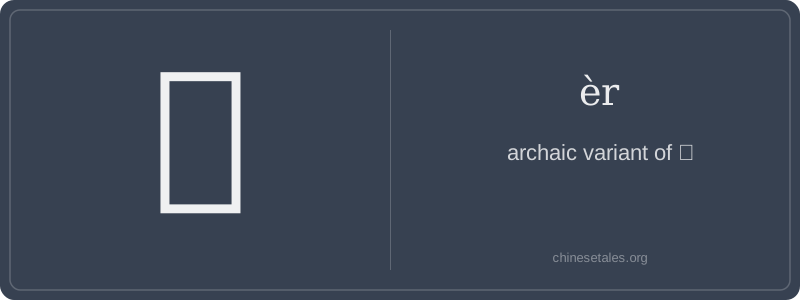
Oracle bone and bronze inscriptions didn’t have 弍 — it emerged much later, during the Warring States and Han periods, as a cursive, clerical-script variant of 貳. The original 貳 combined the ‘shell’ radical (貝, representing currency) with a phonetic component (弋), symbolizing ‘two’ in financial contexts. Scribes began simplifying 貳’s complex form for speed and security, dropping the ‘shell’ and stylizing the top into two parallel lines — but crucially, adding a deliberate leftward flick or dot to distinguish it from plain 二. This wasn’t laziness; it was forensic handwriting design.
By the Tang and Song dynasties, 弍 had crystallized as one of the ‘capital numerals’ (大写数字), enshrined in legal codes like the Tang Code for preventing fraud in tax records and grain ledgers. Classical texts rarely use it poetically — you won’t find 弍 in the Analects or Tang poetry — because its purpose was purely administrative and protective. Its visual economy (just two horizontals plus a telltale mark) embodies an ancient truth: in Chinese bureaucracy, clarity wasn’t about simplicity — it was about making forgery *visually impossible*.
Let’s cut through the confusion: 弍 isn’t a standalone word you’ll use in daily conversation — it’s a fossilized, handwritten variant of 貳 (èr), the formal, anti-fraud numeral ‘two’ used on banknotes, contracts, and checks to prevent tampering. Think of it as Chinese calligraphy’s version of writing ‘twelve’ instead of ‘12’ on a legal document — same meaning, but deliberately harder to alter. Its core feel is *ritual precision*, not casual counting.
Grammatically, 弍 appears only in highly formal, written contexts — never in speech, never in textbooks, and never in compound words like 二十一 (twenty-one). You’ll see it only where authenticity matters: on a promissory note (借条) or an old-style invoice (发票), always paired with other formal numerals like 壹 (yī), 叁 (sān), and 肆 (sì). Example: ‘金额:人民币壹萬弍仟元整’ — notice how 弍 replaces standard 二 in ‘2,000’ to block someone from changing it to ‘3,000’ or ‘5,000’ by adding one stroke.
Culturally, learners often mistakenly treat 弍 as a ‘cool alternative’ to 二 — a classic error! Using it in speech (‘wǒ yǒu 弍 gè píngguǒ’) sounds absurd, like saying ‘methinks’ in a text message. Also, don’t confuse its shape with 二 (just two horizontal lines) — 弍 has three strokes: two horizontals + a tiny connecting hook or dot on the left. That tiny flourish? It’s the ancient scribe’s ‘tamper-proof seal.’