弌
Character Story & Explanation
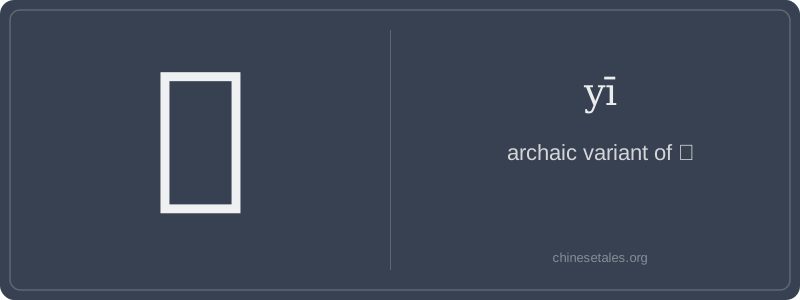
The earliest precursor of 弌 appears not in oracle bones — where 一 was already a simple horizontal line — but in Warring States bamboo slips and Han dynasty seal script, where scribes occasionally added a tiny upward flick at the left end or a subtle curve to distinguish formal numerals in legal or ritual texts. This flourish wasn’t pictographic (there’s no ‘object’ depicted); it was purely stylistic — like adding serifs to a Latin ‘I’. Over centuries, this embellishment crystallized into the distinct form 弌: a horizontal stroke with a delicate, slightly tilted headstroke at the left, resembling a brush lifting with intention rather than resting.
This visual refinement mirrored its semantic elevation: while 一 remained the workhorse numeral, 弌 acquired a quiet dignity — used in early Daoist manuscripts (e.g., the Mawangdui *Yi Jing* variants) to mark ‘primordial unity’ or in Tang dynasty imperial edicts for ceremonial enumeration. Its shape whispers ‘firstness with reverence’: not just ‘one thing,’ but ‘the singular origin’ — echoing the *Daodejing*’s ‘Dao gave birth to One.’ Yet unlike philosophical 一, 弌 never developed abstract extensions; it stayed a formal variant, its beauty its only function.
Imagine you’re holding a Song dynasty inkstone, carefully copying an ancient stele inscription — and there it is: a single, elegant horizontal stroke labeled 弌. Not the familiar 一 you learned on Day One, but its rare, almost ceremonial twin. This isn’t just ‘one’ — it’s ‘one’ dressed in silk robes, reserved for classical texts, seals, and calligraphic art where elegance trumps efficiency. Its meaning is identical to 一 (yī, ‘one’), but its usage is strictly ornamental or archaic: you’ll never hear it spoken aloud in modern Mandarin, and you’ll never type it on your phone — it’s a character that lives only on paper, in museums, and in the quiet reverence of scholars.
Grammatically, 弌 functions exactly like 一: as a numeral, measure word modifier (e.g., 弌匹马), or abstract unity (e.g., 弌心一意). But crucially, it appears *only* in fixed classical collocations or stylistic variants — never in compound words like 一年级 or 一起. Learners sometimes mistakenly insert it into handwritten notes hoping to sound ‘more authentic,’ but native speakers would blink in confusion: it’s like using ‘thou’ in a text message — technically correct, culturally jarring.
Culturally, 弌 is a fossilized echo of Chinese script standardization. When the Qin dynasty unified writing, 一 became the sole official form; 弌 survived only in elite scribal traditions and regional seal scripts. Today, mistaking it for 一 in exams or documents is harmless (they’re interchangeable in meaning), but using it outside historical reenactment or calligraphy signals either deep expertise… or charming anachronism.