弋
Character Story & Explanation
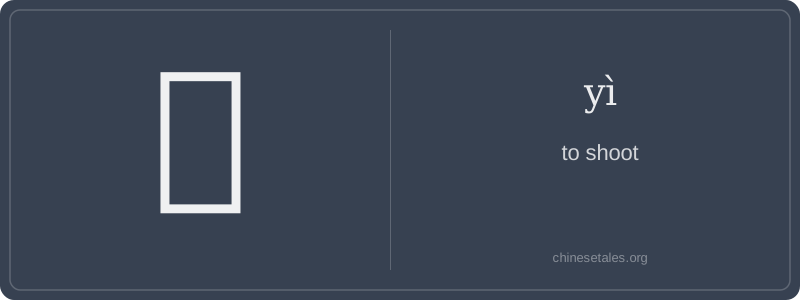
The earliest form of 弋 appears in oracle bone inscriptions as a simple pictograph: a vertical line (representing an upright archer or a post), crossed by a short diagonal stroke (the drawn bowstring), and topped with a tiny curved mark (the arrowhead pointing skyward). Over time, the ‘post’ became the left-falling stroke, the ‘string’ hardened into the horizontal, and the ‘arrowhead’ simplified into the sharp right-falling hook — yielding today’s three-stroke structure: 一 (horizontal), 丿 (left-falling), and 乚 (curved hook). Every stroke is functional — no decoration, all trajectory.
This wasn’t just hunting: in the *Book of Rites*, 弋 described ceremonial archery where nobles shot tethered birds to demonstrate virtue — accuracy reflected moral alignment. The *Analects* even uses 弋 metaphorically: ‘The gentleman does not shoot unless he aims’ (君子无所争,必也射乎 — implying intentionality precedes action). Visually, the character’s asymmetry mirrors archery’s balance: stillness (the horizontal) meeting motion (the falling strokes) — a frozen moment of directed will.
Imagine an ancient archer crouching in tall reeds, drawing his bowstring taut — not to kill, but to *test* the wind, to *aim*, to *direct* energy with precision. That’s 弋 (yì): it doesn’t mean ‘to kill’ or ‘to hunt’ outright — it’s the poised, intentional act of *shooting*, especially in ritual or strategic contexts. It carries a quiet gravity: this is archery as discipline, not sport; as ceremony, not violence.
Grammatically, 弋 is almost never used alone in modern Mandarin. You won’t hear someone say ‘I yì a bird’ — it’s archaic and literary. Instead, it appears embedded in classical compounds (like 弋获 or 弋猎) or as a radical in characters like 式 (shì, ‘pattern’) and 式 (yes, same character — its top component is 弋!), where it subtly conveys ‘directed action’ or ‘regulated form’. Learners sometimes misread it as 代 (dài, ‘to replace’) or 民 (mín, ‘people’) due to stroke similarity — but 弋 has no dot, no hook, just three clean strokes: horizontal, slant, dot-like hook — like an arrow released mid-flight.
Culturally, 弋 evokes Zhou dynasty rituals and Confucian ideals of measured conduct: shooting correctly mattered more than hitting the target. Mistaking it for a verb you can conjugate (e.g., *yìle*, *yìguo*) will sound jarringly archaic — like quoting Homer at a coffee shop. Its power lies in restraint: it’s the silent tension before release, the elegance of aim itself.