廿
Character Story & Explanation
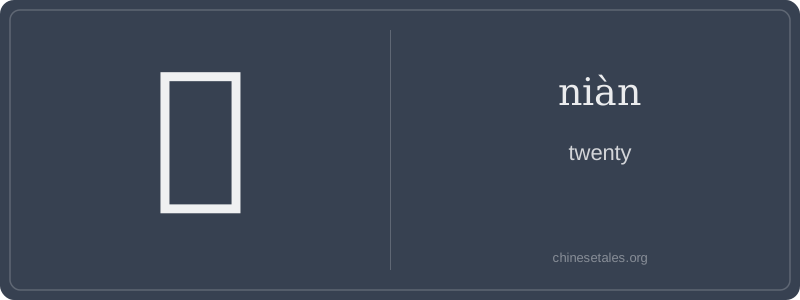
Oracle bone and bronze inscriptions didn’t have 廿 — it emerged later, during the Warring States and Han periods, as a cursive simplification of 二十. Scribes writing quickly on bamboo slips began linking the top stroke of 二 (two horizontal lines) directly to the upper part of 十 (a cross shape), then collapsing the whole thing into two parallel horizontals above 廾 — a radical originally depicting two hands holding something upright. Over centuries, the middle cross of 十 vanished, the two 'twos' fused into one double-line, and the lower 'hands' simplified to the open, upward-cupped form we see today: 一 一 + 廾 = 廿. The four strokes aren’t arbitrary — they’re the visual echo of speed, economy, and scribal muscle memory.
This evolution mirrors how Chinese numerals adapted to material constraints: ink was precious, slips were narrow, and time mattered. By the Tang and Song dynasties, 廿 appeared regularly in poetry and official documents — Li Bai used variants of abbreviated numerals in draft manuscripts, and the *Complete Tang Poems* contains dozens of instances where 廿 subtly evokes brevity and elegance. Its shape doesn’t depict 'twenty' literally — no twenty objects or fingers — but rather the *gesture* of writing twenty swiftly: two strokes for 'two', two strokes for 'ten' (via 廾’s implied duality and verticality), held in balance.
廿 (niàn) is a fossilized numeral — a compact, handwritten shorthand for 'twenty' that feels like stepping into a Qing dynasty ledger or an old Shanghai shop sign. It’s not abstract math; it’s tactile, economical, and deeply rooted in pre-printing-press efficiency. Visually, it’s four strokes: two horizontal lines stacked over the radical 廾 (gǒng), which itself means 'to hold with both hands' — hinting at how early scribes physically bundled symbols together. Unlike modern numerals like 二十 (èr shí), 廿 appears almost exclusively in fixed expressions, dates, and literary or regional contexts — never in formal arithmetic or spoken counting.
Grammatically, 廿 functions only as a noun or adjective meaning 'twenty', and *never* as a verb or standalone quantifier. You’ll see it in phrases like 廿年 (niàn nián, 'twenty years') or 廿世纪 (niàn shìjì, 'twentieth century'), but you’d never say *'廿个苹果'* — that’s ungrammatical; use 二十个 instead. Learners often mistakenly treat it like a regular number and try to combine it with measure words — a red flag that instantly marks non-native usage.
Culturally, 廿 carries quiet prestige: it’s the character of calligraphers, historians, and Cantonese speakers (where it’s still heard in speech: 'jaa6' — e.g., 'jaa6 ci3' for 'twice'). Its absence from HSK reflects its status as a 'living relic' — functional but optional, elegant but archaic. Think of it less as vocabulary and more as linguistic calligraphy: beautiful, precise, and best appreciated when you know *why* it survives.