廾
Character Story & Explanation
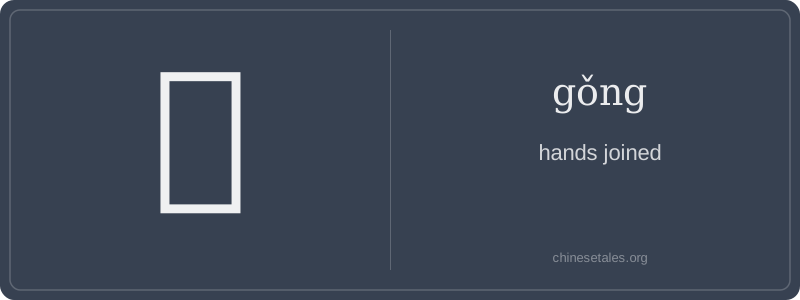
The earliest form of 廾 appears in Shāng dynasty oracle bone inscriptions as a clean, symmetrical pictograph: two upward-curving arms with open palms facing inward — like a mirror image of each other, meeting at a central point. Imagine drawing two soft 'U' shapes back-to-back, then adding a short horizontal line where the wrists meet — that’s the original essence. Over centuries, the curves tightened into angular strokes: the left 'arm' became a downward-left stroke (丨), the right 'arm' a downward-right stroke (丿), and the connecting 'wrist' simplified into a flat, unbroken horizontal (一). By the Qin small seal script, it had stabilized into the crisp, balanced 3-stroke form we write today — still unmistakably two hands rising in unison.
This visual clarity preserved its meaning across millennia. In the *Shuōwén Jiězì* (121 CE), China’s first dictionary, Xu Shen defines 廾 as 'two hands holding something up' — citing its use in words like 弁 (ceremonial cap worn by nobles) and 式 (ritual pattern), both implying formal, handed-down conduct. Even in the *Analects*, Confucius describes proper conduct as 'holding ritual vessels with both hands' — a physical act mirrored precisely by 廾’s shape. Its endurance isn’t accidental: in a culture where gesture encoded hierarchy and virtue, a character that captured 'respectful hands' needed no embellishment — just balance, symmetry, and intention.
Think of 廾 (gǒng) as Chinese calligraphy’s version of a 'handshake emoji' — but way older and more serious. It doesn’t stand alone in modern speech like 'hello' or 'thanks'; instead, it’s a silent, ancient gesture fossilized in writing: two hands raised and joined together, palms up — the universal posture of offering, respect, or solemn presentation. In Classical Chinese, this wasn’t just a picture; it was a verb meaning 'to hold up with both hands', often used when presenting tribute, ritual offerings, or documents to elders or rulers. You’ll never see it solo in a WeChat message, but you *will* spot it embedded in dozens of high-frequency characters — like 弁 (biàn, ceremonial cap), 式 (shì, formula), or 异 (yì, different) — where it silently signals 'hands engaged in meaningful action'.
Grammatically, 廾 itself is functionally extinct as an independent word in spoken Mandarin — no native speaker says 'gǒng' to mean 'hands joined'. But its power lies in its role as a radical (Radical 53) and semantic clue. When you see 廾 at the bottom of a character, it’s whispering: 'this word involves deliberate, respectful, or ritualized hand use'. Learners often mistakenly treat it as a standalone vocabulary item (like trying to use 'thou' as a modern pronoun), or confuse it with similar-looking radicals like 廿 (niàn, twenty) or 十 (shí, ten). Don’t memorize it as a word — memorize it as a *gesture signature*.
Culturally, this humble three-stroke shape carries Confucian gravity: the joined-hands gesture (gǒngshǒu 拱手) remains a traditional greeting, especially during Lunar New Year or ancestral rites — a non-verbal 'I honor your presence'. Interestingly, the character’s minimalism (just three strokes!) contrasts sharply with its weighty connotations: reverence, submission, ceremony. Mistake it for a number or a punctuation mark, and you’ll miss the quiet dignity woven into hundreds of characters — from 'law' (律 lǜ, which contains 廾) to 'ceremony' (式 shì). It’s not flashy — but it’s foundational.