廱
Character Story & Explanation
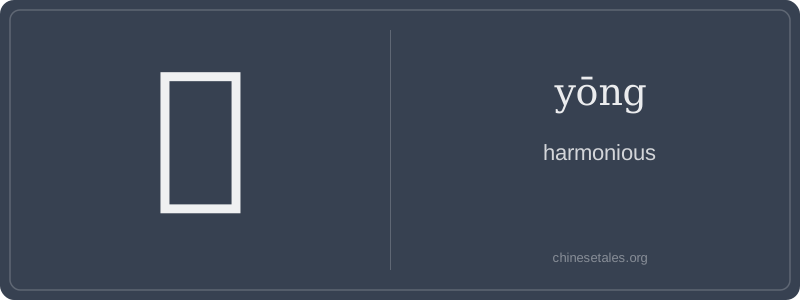
The earliest form of 廱 appears in bronze inscriptions of the Western Zhou dynasty (c. 1046–771 BCE) as a complex pictograph: a bell-shaped vessel (indicating sound) flanked by two mouths (口) — symbolizing multiple voices singing together — all enclosed within a boundary (the radical 广, meaning ‘hall’ or ‘sheltered space’). Over centuries, the double mouths merged into the top component 亠 + 乡 (a stylized phonetic hint), while the bell morphed into 禺 (yú), a phonetic element borrowed for its sound — though ironically, 禺 itself means ‘a mythical horned creature’, adding a layer of archaic mystique.
This character first appeared in the *Classic of Poetry* (Shījīng), where 廱喈 (yōng jiē) describes the harmonious chanting of court musicians during ancestral rites. In the *Book of Rites*, it’s linked to proper conduct in music — ‘When the music is 廱, the people’s hearts are aligned.’ Visually, the enclosing 广 radical suggests harmony isn’t chaotic or free-form; it must occur *within structure*: a hall, a ritual framework, a shared moral space. That architectural containment is why 廱 feels so solemn — harmony, here, is both gift and responsibility.
At its heart, 廱 (yōng) isn’t just ‘harmonious’ — it’s the ancient, resonant harmony of ritual music vibrating through bronze bells and courtly ceremony. Unlike modern, casual words like 和 (hé, 'and' or 'peaceful'), 廱 evokes a profound, almost sacred balance: voices blending in unison, instruments tuned to cosmic pitch, rulers governing with benevolent synchrony. It’s harmony as *attunement* — not mere absence of conflict, but active, cultivated resonance.
Grammatically, 廱 is rare in spoken Mandarin today; you’ll almost never hear it in daily conversation. It appears mainly as a literary or classical adjective — always before nouns (e.g., 廱喈 yōng jiē, 'harmonious and clear') or in fixed poetic compounds. Learners often mistakenly try to use it like 和谐 (héxié), but 廱 carries no colloquial flexibility: it doesn’t take aspect particles (了, 过), can’t be reduplicated, and never stands alone as a predicate (*‘This is yōng’* is ungrammatical). Its power lies in weight, not utility.
Culturally, 廱 reflects the Confucian ideal that harmony isn’t passive agreement but the result of disciplined cultivation — like tuning a set of bianzhong bells to match the celestial order. Modern learners sometimes misread it as related to 雍 (yōng, same pronunciation, meaning ‘elegant, stately’) — a common slip, since the characters look nearly identical. But 廱 is rarer, more musical, and exclusively tied to sonic/ritual unity — a subtle but vital distinction.