廨
Character Story & Explanation
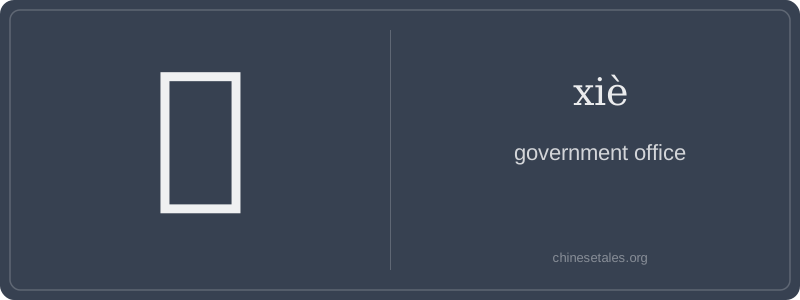
The earliest form of 廨 appears in Han dynasty clerical script, evolving from a combination of 广 (a shelter or roof — the left radical) and 寫 (xiě, 'to write/dictate', later simplified to 尚 + 冖 + 乂). In oracle bone inscriptions, there’s no direct precursor, but by the Eastern Han, the character fused the idea of a covered space (广) where official writing and record-keeping occurred (the right side, originally 寫, implying documentation and dispatch). The 16 strokes crystallize this: the broad roof shelters meticulous administrative work — note how the lower right component resembles stylized brushstrokes and sealed documents.
By the Tang dynasty, 廨 was standard in official titles like 州廧 (zhōu xiè, 'prefectural office') and 縣廧 (xiàn xiè, 'county office'). The Old Book of Tang uses it when describing Li Deyu’s reforms: '凡州廧之吏,必稽其籍' ('All clerks in prefectural offices must have their registers verified'). Its visual form reinforces meaning: the expansive 广 radical literally 'covers' the act of governance — not just housing officials, but sheltering the written word as law. Even today, its shape whispers 'where decrees are penned and sealed.'
廨 is a rare but elegant character meaning 'government office' — not just any office, but specifically an official administrative bureau in imperial or formal contexts. Think of it as the classical cousin of modern 办公室 (bàn gōng shì), carrying gravitas and historical weight. Its core feeling is bureaucratic dignity: quiet corridors, ink-stained desks, and documents stamped with red seals. You’ll almost never hear it in daily speech — it’s a literary fossil, preserved in formal writing, historical novels, and place names.
Grammatically, 廨 functions exclusively as a noun and appears almost always in compound words, never alone. It rarely takes modifiers like adjectives directly; instead, it follows descriptive nouns (e.g., 州廧 → 'prefectural office'). Unlike common nouns like 部 (bù) or 局 (jú), 廨 cannot be pluralized with 们 or quantified with 个 — it’s inherently singular and institutional. Learners mistakenly try to use it like a generic 'office' (e.g., *我的廧*), but that sounds archaic and jarring — like saying 'mine hall' instead of 'my office' in English.
Culturally, 廨 evokes Tang–Song era bureaucracy — imagine Du Fu drafting petitions in a county yamen. Modern usage is mostly poetic or nostalgic: seen on plaques of restored Ming-Qing government buildings or in scholarly essays on administrative history. A key pitfall? Confusing it with 謝 (xiè, 'to thank') — same pronunciation, totally unrelated meaning and origin. Also, don’t mix it up with 廈 (shà/xià, 'large building'), which shares the 广 radical but has no bureaucratic connotation.