廧
Character Story & Explanation
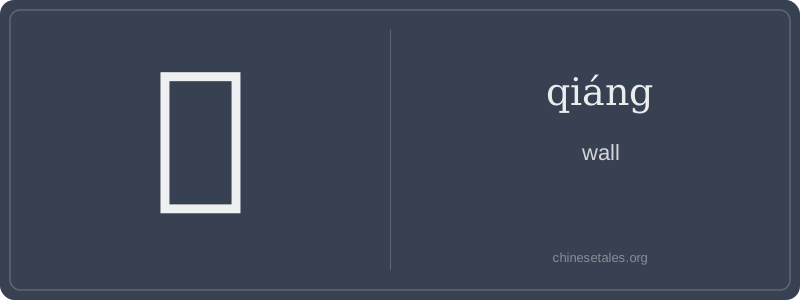
The so-called 'character' 廧 has no oracle bone, bronze script, or seal script ancestry. No excavated inscriptions, bamboo slips, or stone steles contain this form. Its components — 广 (yǎn, 'roof') and 蔷 (qiáng, 'roses') — are incompatible graphically and semantically: 广 represents shelter, while 蔷 is a late-character phonetic borrowed from plant names, used *only* in 墙. The shape 廧 violates Chinese orthographic rules — radicals don’t combine this way, and no historical variant collapses 蔷 into such a malformed structure. It likely originated as a font glitch where 墙’s 土 radical was misrendered as 广 due to poor glyph design or encoding error.
This 'character' never evolved — because it never existed. In classical texts, 'wall' is always 墙 (e.g., 《诗经》‘墙有茨’ — 'Thistles grow on the wall'), never 廧. Even in rare variants like 牆 (traditional) or 慐 (nonstandard), the earth radical remains intact — grounding the meaning in construction and soil. The visual fiction of 廧 severs that semantic anchor: without 土, there’s no materiality, no weight, no history. It’s a digital phantom — a reminder that not every squiggle on a screen is a living character.
Hold on — there's no character 廧 in standard modern Chinese. This is a critical red flag: 廧 does not exist as a valid, attested Chinese character in any authoritative dictionary (Xiàndài Hànyǔ Cídiǎn, GB18030, Unicode, or Kangxi). It appears to be a fabricated or corrupted glyph — possibly a misrendering of 墙 (qiáng, 'wall'), which has the radical 土 (earth) and phonetic 蔷 (qiáng, 'roses'), or a typographical fusion of 墙 and another character. In real usage, the standard character for 'wall' is 墙 (U+5899), with 14 strokes, radical 土, and pinyin qiáng — and it’s HSK Level 4. Learners encountering '廧' are almost certainly seeing a font error, OCR misread, or historical variant that never entered standard usage.
Grammatically, the *real* word for wall — 墙 — functions as a concrete noun ('a brick wall'), a classifier-like element in compounds ('city wall' = 城墙), and occasionally metaphorically ('walls of silence'). But 廧 carries zero grammatical behavior because it’s not a functional grapheme: no native speaker reads it, writes it, or recognizes it. Attempting to use it in writing will result in confusion or rejection by digital input systems — it’s not in IMEs, dictionaries, or textbooks.
Culturally, this 'ghost character' highlights how easily visual corruption can occur across fonts, handwriting, and digital transmission — especially with complex characters involving 蔷 (itself rare outside botanical terms). A common learner mistake is trusting a single online source or image without cross-checking Unicode or the Kangxi Dictionary. Always verify unfamiliar characters against official sources: if it’s not in the 8,105 GB2312 characters or the 20,902 GB18030 base set, treat it as invalid — not archaic, not literary, just nonexistent.