廥
Character Story & Explanation
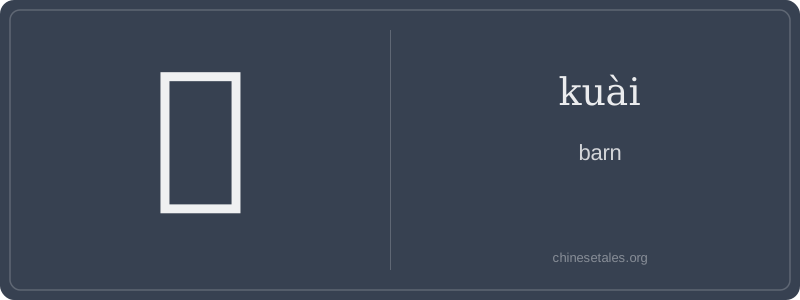
The earliest form of 廥 appears in bronze inscriptions from the Western Zhou period — a vivid pictograph showing a large open-roofed structure (the 广 radical) with stacked bundles of hay or straw inside, represented by the 貴 component below. Over centuries, the upper part simplified from a detailed thatched roof to the clean 广 (yǎn) — meaning 'broad shelter' — while the lower part evolved from a stylized depiction of valuable grain stores into 貴 (guì), which originally meant 'to value highly' but here functions phonetically and semantically: precious stored resources deserve protection. The 16 strokes encode both function (shelter + storage) and status (valued goods).
By the Warring States period, 廥 was already used in texts like the *Book of Lord Shang* to denote state-controlled fodder depots critical for maintaining chariot armies. In the *Zuo Zhuan*, it appears in contexts of famine relief: 'opening the public 廥' meant releasing emergency grain reserves. Its visual logic remains strikingly literal — the broad roof (广) shelters the precious commodity (貴), making it one of Chinese writing’s most transparent semantic-phonetic compounds. Even today, scholars smile at how perfectly this character maps ancient logistical reality onto ink and paper.
廥 (kuài) is a beautifully archaic word for 'barn' — not just any storage shed, but a large, official granary or fodder storehouse, often associated with imperial logistics, military supply chains, or wealthy estates. It carries a weighty, bureaucratic dignity: think less 'farm shed' and more 'state-run silo.' You’ll almost never hear it in daily conversation — modern Mandarin prefers 仓库 (cāngkù) or 粮仓 (liángcāng). Instead, 廥 lives in classical texts, historical novels, and formal agricultural policy documents — it’s the kind of word that appears when describing how the Han dynasty stored winter hay for cavalry horses.
Grammatically, 廥 is a noun only — no verb forms, no adjectival use. It’s typically preceded by measure words like 座 (zuò) or 间 (jiān), and often modified by descriptors like 官 (guān, 'official') or 私 (sī, 'private'). You might read 官廥三座 (guān kuài sān zuò) — 'three official barns' — but never *廥了 (kuài le) or *廥地 (kuài dì). Learners sometimes misread it as kuì (like 贵) or confuse its 广 radical with the 'roof' radical 宀 — but 广 here signals 'open shelter,' not 'covered dwelling.'
Culturally, 廥 evokes pre-modern China’s obsession with grain security — where barns were strategic infrastructure, guarded and inventoried like armories. A common mistake? Assuming it’s interchangeable with 棚 (péng, 'shed') or 圈 (quān, 'pen') — but those imply temporary or animal-specific structures, while 廥 implies permanence, scale, and administrative oversight. Its rarity makes it a quiet marker of textual sophistication: spotting 廥 in a passage instantly signals classical or technical register.