廛
Character Story & Explanation
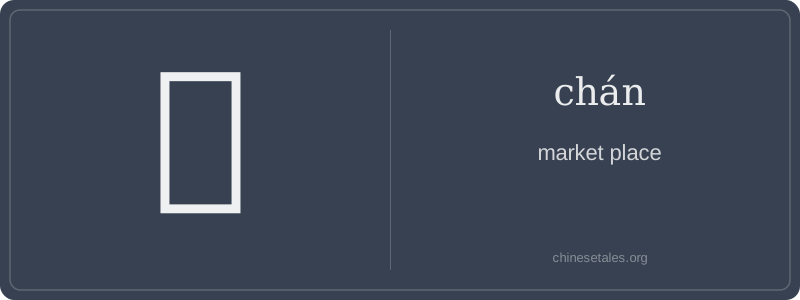
The earliest form of 廛 appears on Warring States bamboo slips as a compound pictograph: a wide-roofed structure (广) enclosing a phonetic element (覃, later simplified to 舟 + 土), suggesting a sheltered, designated space for goods. The radical 广 (yǎn) — meaning ‘wide roof’ or ‘veranda’ — anchors it visually as architecture, not open-air activity. Over centuries, the inner component evolved: the original 覃 (tán, ‘profound; spread out’) was gradually reanalyzed and reshaped into 舟 (zhōu, ‘boat’) atop 土 (tǔ, ‘earth’), perhaps reflecting how early market plots were assigned near waterways and city walls — practical logistics encoded in stroke order.
By the Han dynasty, 廛 was codified in legal texts like the Han Officials’ Handbook as a unit of urban land — precisely 100 paces square, assigned to merchants by the government and subject to taxation. In the Book of Rites, it appears in rituals governing market conduct, reinforcing its role as a civil institution. Its visual ‘roof-over-earth’ shape perfectly mirrors this duality: protection (the roof) granted only upon formal allocation (the earth beneath). Even today, when scholars reconstruct ancient Chang’an’s layout, they use 廛 to mark those exact, measured, state-sanctioned plots — a 2,300-year-old address system frozen in ink.
At its heart, 廛 (chán) isn’t just ‘market place’ — it’s the ancient, walled, tax-registered commercial plot where merchants *officially* set up shop in Zhou and Han dynasty cities. Think less ‘bustling street market’ and more ‘licensed downtown storefront with a municipal permit’. This character carries bureaucratic weight: it implies legitimacy, fixed location, and state oversight — a far cry from the fluid, informal markets evoked by 市 (shì) or 集 (jí). You’ll almost never hear it in modern spoken Chinese; it lives exclusively in classical texts, historical scholarship, and formal compound words.
Grammatically, 廛 is strictly a noun — and a rare, literary one at that. It never stands alone in speech; you won’t say ‘Let’s go to the chán!’ Instead, it appears embedded in classical-style phrases like 廛里 (chán lǐ, ‘market district’) or as part of bureaucratic terms like 廛税 (chán shuì, ‘shop tax’). Learners sometimes misread it as a variant of 蟾 (chán, ‘toad’) due to the shared pronunciation and top component, but there’s zero semantic link — confusing them is like mixing up ‘kiosk’ and ‘kangaroo’.
Culturally, 廛 reveals how deeply Chinese civilization tied commerce to urban planning and governance: markets weren’t organic growths but deliberately allocated, surveilled spaces — a reflection of the Confucian ideal where even trade served social order. Modern learners often overestimate its frequency; if you encounter it, you’re likely reading the Rites of Zhou or an inscription on a bronze vessel — not ordering baozi.