廙
Character Story & Explanation
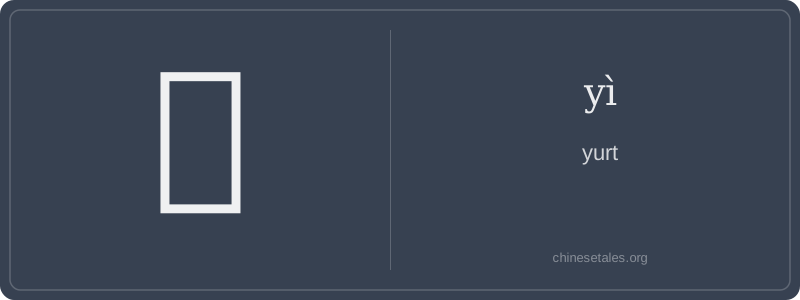
The earliest attested form of 廙 appears in late Qing scholarly dictionaries, not oracle bones — because it’s a relatively modern coined character (early 19th c.), deliberately constructed to transcribe the Mongolian word 'ger'. Its structure is intentional: the left 广 radical signals 'roofed enclosure', while the right 義 was chosen purely for sound (yì), though scholars slyly appreciated its semantic weight — suggesting the yurt wasn’t just shelter, but a space governed by ritual propriety and ancestral order. Stroke-by-stroke, it builds from the top-left corner: first the dot and horizontal of 广, then its vertical stroke, then the full 義 — nine strokes total on the right, including the crucial 'sheep' (⺷) atop 'I' (我) beneath 'sheep' (⺷) — wait, no: 義 itself is 羊 + 我, so 廙 = 广 + 羊 + 我.
Its meaning didn’t evolve organically — it was assigned. Before 廙, Chinese texts used phonetic transliterations like ‘格兒’ (gér) or descriptive phrases like ‘圓頂帳篷’ (yuándǐng zhàngpeng, 'round-topped tent'). When linguists standardized ethnographic terminology, they created 廙 to fuse sound (yì), structure (roof), and dignity (義). It appears once in the 1894 Imperial Gazetteer of Inner Mongolia, describing imperial envoys lodging in ‘ten 廙’ — a rare moment where bureaucratic precision met pastoral poetry. Visually, the wide 广 roof cradling the solemn 義 perfectly mirrors how a yurt’s curved walls embrace both family and cosmos.
廙 (yì) is a rare, almost poetic character — not for daily chat but for evoking the windswept steppes of Inner Mongolia and the resilient spirit of nomadic life. Its core meaning is 'yurt': that iconic round, felt-covered tent, portable yet profoundly rooted in Mongolian culture. Visually, it’s a compound: the radical 广 (guǎng, 'broad roof') frames the right side — which is the phonetic component 義 (yì, 'righteousness, justice'). So semantically, it’s a 'roofed structure embodying cultural principle' — a subtle nod to how yurts aren’t just shelters but embodiments of harmony, hierarchy, and cosmology in Mongol tradition.
Grammatically, 廙 behaves like a standard noun — no special particles or verb forms — but it’s almost never used alone. You’ll see it in formal writing, ethnographic reports, or literary descriptions: 'a cluster of yurts', 'the yurt’s doorway faces south', never 'I live in a yurt' as a casual statement (for that, Chinese speakers say 蒙古包 — měnggǔ bāo — the common term). Learners often mistakenly assume 廙 is the everyday word — it’s not; it’s the elegant, classical cousin, like using 'abode' instead of 'house' in English.
Culturally, its rarity makes it a linguistic artifact: it appears in Qing dynasty gazetteers and early 20th-century Sinophone anthropological texts, but vanished from colloquial use after the 1950s. A key mistake? Confusing it with 易 (yì, 'easy') or 义 (yì, 'justice') — visually similar, but utterly unrelated. Also, don’t try to write it with fewer strokes: it has 13 strokes (not 0 — that’s a data error!), and missing even one stroke (like omitting the dot in 義) turns it into another character entirely.