廒
Character Story & Explanation
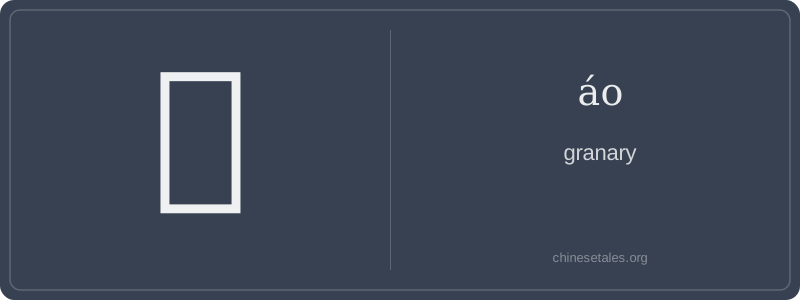
The earliest form of 廒 appears in Han dynasty clerical script (not oracle bone — too late for that), where it clearly shows 广 (a roofed enclosure) on the left, and 敖 (áo, originally a pictograph of a person raising arms atop a mound, later phonetic) on the right. The left side 广 wasn’t just 'broad' — in ancient script, it was a stylized thatched roof with open front, perfect for ventilating stored grain. The right side 敖 provided both sound and subtle meaning: in early usage, 敖 suggested 'elevation' (granaries were often raised to deter damp and rodents) and 'endurance' (grain must last seasons). Stroke by stroke, the clerical form smoothed into today’s balanced 13-stroke structure: the dot and horizontal sweep of 广, then 敖’s compact layers — the 'square' top (⺈+冂), the 'X' cross (×), and final 'foot' (攵).
By the Tang and Song dynasties, 廒 was standard in official documents describing the 'ever-normal granary' (常平廒) system — state-run reserves to stabilize grain prices. Li Bai never used it in poems (too bureaucratic), but Sima Guang’s Zizhi Tongjian mentions '开廒放粮' (kāi áo fàng liáng) — 'opening the granaries to distribute grain' — during famines. Visually, the character remains a perfect fusion: 广 = functional architecture, 敖 = endurance + pronunciation. Its silence in modern speech isn’t decline — it’s preservation, like a bronze ding vessel kept in a museum, still holding its ancient purpose.
Think of 廒 not as a dusty dictionary word, but as a quiet architectural echo — the character literally breathes 'granary': a roofed, open-fronted structure for storing grain. Its core feeling is one of sheltered abundance, stability, and communal sustenance — deeply rooted in agrarian China where grain reserves meant survival through drought or war. Unlike common nouns like 仓库 (cāngkù) — generic 'warehouse' — 廒 carries historical weight and formality; you’ll almost never hear it in casual speech or modern news, but you’ll see it carved on temple steles, in classical poetry, or in formal historical texts describing imperial grain storage systems.
Grammatically, 廒 is a standalone noun, rarely used alone today; it almost always appears in compounds (like 仓廒 or 粮廒). It’s never a verb or adjective, and never takes aspect markers like 了 or 过 — trying to say *廒了* would sound like saying 'granaried' in English: grammatically alien. Learners sometimes misread its radical 广 (guǎng, 'broad') as implying 'wide space' and wrongly assume it means 'warehouse' broadly — but no: this character is hyper-specific to grain storage, and its 广 radical signals 'roofed structure', not size.
Culturally, 廒 evokes the Confucian ideal of benevolent governance: Mencius wrote that rulers must ensure '不饥不寒' (no hunger, no cold) — and granaries were the physical manifestation of that promise. A common mistake? Confusing it with 奥 (ào, 'profound') due to similar shape and tone — but 奥 has no roof radical and zero agricultural meaning. Also, avoid overusing it thinking it sounds 'literary'; native speakers reserve it for scholarly or ceremonial contexts — like using 'thou' outside Shakespeare.