廑
Character Story & Explanation
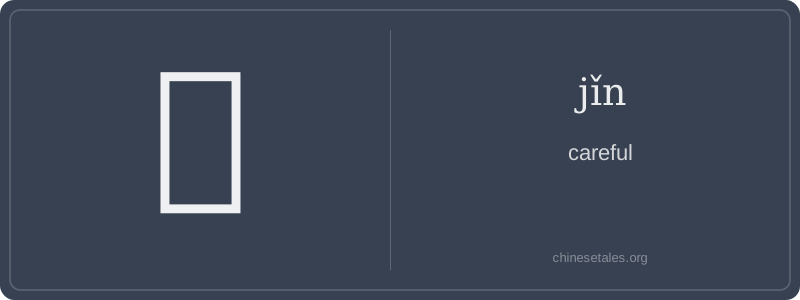
The earliest form of 廑 appears in bronze inscriptions as a compound pictograph: a broad roof radical (广) sheltering two hands (廾) holding a small, upright object — possibly a ritual tablet or tally stick. Over time, the hands simplified into the lower component 堇 (jǐn), which originally depicted a person kneeling beside clay (土) and fire (灬), suggesting 'ritual preparation under supervision'. By the seal script era, 广 + 堇 fused into today’s structure: the roof implies 'protection' or 'scope', while 堇 adds the sense of 'solemn attention' — literally, 'care under cover of reverence'.
This visual logic shaped its semantic evolution: from early Zhou dynasty texts, 廑 described meticulous conduct in ancestral rites; by the Han, it broadened to mean 'scrupulousness in moral affairs'. The Book of Rites (Lǐjì) uses it in passages urging officials to 廑思 (jǐn sī, 'think with scrupulous care') before issuing decrees. Interestingly, the character’s 'roof' radical doesn’t imply physical shelter — rather, it frames the act of care as something contained, intentional, and socially bounded: true caution isn’t reactive panic — it’s deliberate, structured, and context-aware.
At first glance, 廑 (jǐn) feels like a quiet, almost old-fashioned word for 'careful' — but it’s far more nuanced than that. In classical and literary Chinese, it carries a sense of *attentive reverence*: not just watching your step, but guarding something precious — a duty, a promise, or the delicate balance of human relationships. It’s rarely used in casual speech today (hence its absence from HSK), but appears in formal writing, idioms, and classical allusions where precision and moral weight matter.
Grammatically, 廑 functions as an adjective or adverb, often paired with verbs like 慎 (shèn, 'to be prudent') or used in set phrases like 廑慎 (jǐn shèn). You’ll almost never see it alone as a predicate ('He is 廑') — instead, it modifies action: 廑言 (jǐn yán, 'speak carefully'), 廑行 (jǐn xíng, 'act cautiously'). Learners sometimes mistakenly treat it like 紧 (jǐn, 'tight/urgent'), but they’re unrelated in meaning and etymology — a classic trap that turns 'exercise caution' into 'pull tight!'
Culturally, 廑 reflects the Confucian ideal of *mindful restraint*: carefulness isn’t timidity — it’s ethical vigilance. Think of a scholar copying ancient texts by hand, checking each stroke twice; that’s 廑. Modern learners miss this depth when translating it simply as 'careful' — it’s closer to 'conscientiously attentive', implying responsibility and consequence. And yes — even native speakers pause before using it, because deploying 廑 signals you’re stepping into solemn, literate territory.