庼
Character Story & Explanation
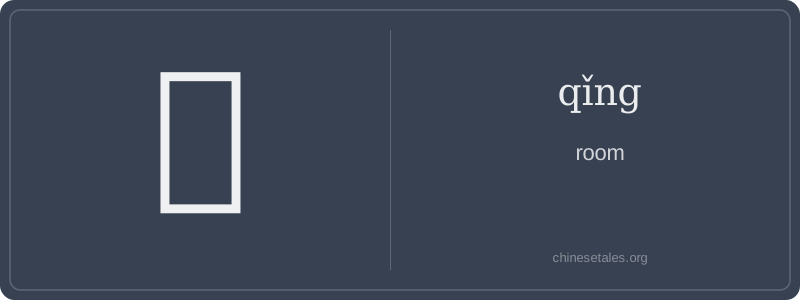
The earliest form of 庼 appears in bronze inscriptions of the late Zhou dynasty (c. 5th century BCE) as a stylized pictograph: a roof (宀 mián radical) sheltering two simplified strokes representing a person seated cross-legged inside — not just shelter, but intentional, cultivated enclosure. Over centuries, the ‘person’ element evolved into the right-hand component 顷 (qǐng), originally meaning 'a moment' or 'a tilt' (suggesting a gentle, inclined posture), while the roof radical solidified as the top enclosure. By the Han dynasty, the character stabilized into its current shape: 宀 + 顷 — visually echoing both shelter and mindful presence within it.
This dual origin explains its enduring literary weight: 庼 isn’t generic space — it’s *human-scaled, intentioned space*. In the Classic of Poetry (Shījīng), 庼 appears in odes describing scholars’ retreats ('the pine-shaded 庼 where brush meets silk'). Later, in Song dynasty garden manuals, 庽 (a variant) denoted small, asymmetrical pavilions designed for single-view meditation — reinforcing how the character’s visual structure (roof + ‘tilt’) encodes both architecture and attitude. Its rarity today isn’t decline — it’s preservation: a linguistic bonsai, pruned to perfection for poetic use only.
Imagine you’re wandering through a quiet, centuries-old scholar’s garden in Suzhou — not the bustling tourist path, but a tucked-away pavilion where inkstones rest on lacquered desks and scrolls hang softly in the breeze. That hushed, intimate space? That’s 庼 (qǐng): not just any room, but a refined, self-contained chamber — often poetic, literary, or architectural. It evokes atmosphere more than square footage: a place for contemplation, calligraphy, or quiet conversation. Unlike the neutral 房 (fáng) or functional 室 (shì), 庼 carries elegance and restraint — think 'study', 'pavilion', or 'bower'.
Grammatically, 庼 is almost never used alone in modern speech; it appears exclusively in classical compounds or literary set phrases. You’ll see it in poetry, temple inscriptions, or historical novels — never in 'my bedroom is big' (that’s 卧室 wòshì). It’s a noun only, never a verb or adjective, and it resists measure words like 个 (gè); instead, it pairs with classical counters like 一楹 (yī yíng) — literally 'one beam-span', reflecting its architectural roots. Learners mistakenly try to substitute it for 房 or 室 — a subtle error that instantly marks their language as bookish or anachronistic.
Culturally, 庼 whispers of literati aesthetics: harmony between human space and nature, understated beauty, and scholarly retreat. It’s absent from HSK because it’s functionally obsolete in daily life — yet remains vital for reading Tang poetry or understanding classical garden design. Mistake it for 空 (kōng, 'empty') or 庭 (tíng, 'courtyard'), and you’ll misread entire passages about spatial hierarchy in Ming-era texts.