庥
Character Story & Explanation
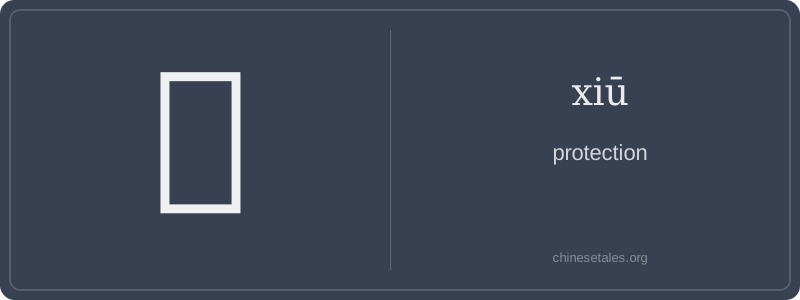
The earliest form of 庥 appears in bronze inscriptions as a pictograph combining 广 (a wide, overhanging roof) with 丑 (chǒu), which originally depicted a hand holding a tool — but here, it's stylized into a simplified, bent-arm shape suggesting 'support' or 'upholding'. Over centuries, the lower component evolved: 丑 lost its tool-like detail and became more abstract, while 广 retained its sweeping left-falling stroke — together, they formed a clear visual metaphor: 'a roof upheld by caring hands'. By the seal script era, the structure solidified into today’s 9-stroke form, with the 广 radical anchoring the meaning of shelter and the right side hinting at intentional, embodied care.
This character flourished in pre-Qin and Han texts as a moral descriptor — not for military defense, but for virtuous guardianship. In the Book of Rites (Lǐjì), 庥 appears in phrases like 庥民 ('shelter the people'), framing governance as compassionate refuge. Its visual logic remains striking: the broad 广 roof literally shelters the smaller, supportive form beneath — a rare case where the character’s layout *is* its philosophy. Even today, when carved above temple gates or on ancestral tablets, 庥 silently declares: 'Here, safety is not passive — it is held, honored, and sustained.'
At its heart, 庥 (xiū) is a quiet but potent character meaning 'protection' — not the flashy kind with shields and swords, but the deep, sheltering kind: like a roof over your head, a guardian’s steady presence, or ancestral care wrapping around a family. It carries warmth, stability, and moral weight — think of it as 'benevolent shelter', not just physical cover. Unlike common protection words like 保护 (bǎohù), which is active and modern, 庥 feels classical, poetic, and slightly formal — you’ll rarely hear it in daily chat, but you’ll see it in inscriptions, poetry, or compound terms where reverence matters.
Grammatically, 庥 almost never stands alone. It functions exclusively within compounds (like 庥荫 or 庥护), and it’s never used as a verb by itself — no 'I xiu you' constructions! Learners sometimes mistakenly try to use it like 保 or 护, but that’s a dead end. Instead, it appears as the first element in two-character nouns or verbs, often paired with characters that reinforce care, growth, or legacy — e.g., 庥荫 (xiū yìn) means 'protective shade', evoking the image of an old tree shielding younger branches.
Culturally, 庥 echoes Confucian ideals of benevolent stewardship: elders protecting juniors, rulers safeguarding people, nature nurturing life. A classic mistake is misreading it as 修 (xiū, 'to cultivate') — same sound, totally different meaning and shape. Also, because it’s absent from HSK and most textbooks, learners often miss its subtle role in literary or ceremonial language, where it adds gravitas and time-honored resonance.