庤
Character Story & Explanation
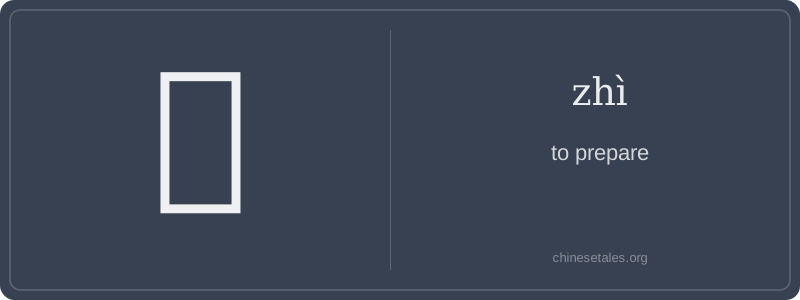
The earliest form of 庤 appears in Warring States bamboo slips as a composite glyph: the left side was a simplified variant of 豕 (shǐ, 'pig'), and the right side resembled 攵 (pū, 'to tap' or 'to act with hands') — not the modern radical 攵 we see today, but an earlier hand-with-stick shape. Over centuries, the pig component morphed into the top part (尸 + 一 + 丿) while the action component streamlined into 攵, yielding the current structure. Visually, it’s a pig being carefully guided or positioned — a vivid image of intentional arrangement, not slaughter or consumption.
This pictorial logic anchored its meaning: in the Rites of Zhou and Book of Rites, 庤 consistently describes the solemn, prescribed arrangement of ritual objects — wine vessels, mats, sacrificial animals — where misplacement wasn’t sloppy, but spiritually dangerous. Even in Tang poetry, Du Fu used 庤 in lines about preparing inkstones and scrolls, linking material order to moral clarity. The character never drifted into colloquial use; its visual weight kept it tethered to reverence, not routine.
Think of 庤 (zhì) as the Chinese equivalent of a meticulous stagehand in a Shakespearean theater — unseen but absolutely essential: before the curtain rises, they’ve already prepared every prop, cue, and costume. Its core meaning — 'to prepare', 'to arrange with care' — carries quiet intentionality, not urgency or force. Unlike common verbs like 准备 (zhǔnbèi), which is neutral and modern, 庤 feels classical, deliberate, and almost ritualistic — like laying out tea utensils for a Chan ceremony or arranging ancestral tablets before Qingming.
Grammatically, 庤 is almost exclusively literary or archaic: it appears as a transitive verb, often in formal written contexts or classical allusions, and rarely in spoken Mandarin. You’ll find it in phrases like 庤酒 (zhì jiǔ, 'to set out wine') or 庤席 (zhì xí, 'to arrange seating'), never in casual speech like 'I prepared lunch'. Learners mistakenly try to use it conversationally — a red flag that instantly marks you as quoting from the Book of Rites, not ordering takeout.
Culturally, 庤 embodies Confucian precision: preparation isn’t just practical — it’s ethical. To 庤 something is to honor hierarchy, timing, and propriety. A common mistake is overgeneralizing it as a synonym for 做 (zuò, 'to do') or 搞 (gǎo, 'to handle'); doing so flattens its layered resonance. It’s not about action — it’s about *rightful placement before action begins*.