庋
Character Story & Explanation
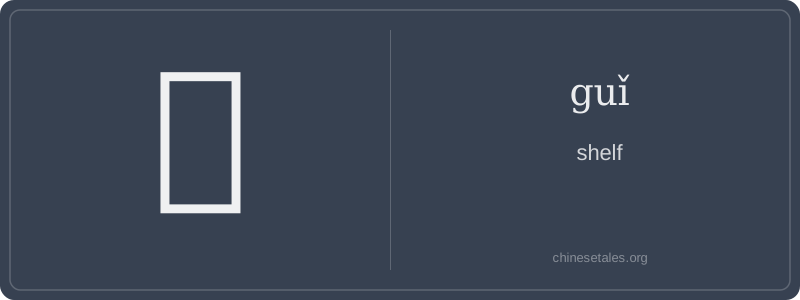
The earliest form of 庋 appears in bronze inscriptions of the Western Zhou (c. 1046–771 BCE) as a pictograph showing a wide-roofed structure (the precursor to 广) with two horizontal lines beneath — representing parallel wooden beams or ledges built into a wall. Over centuries, the roof broadened into the modern 广 radical (symbolizing a sheltered space), while the inner component evolved from 友 (yǒu) — not 'friend', but an ancient phonetic loan depicting crossed timbers — into 乚 + 厶, simplifying into today’s clean 7-stroke form: a broad 'roof' (广) sheltering a compact, anchored base (丿 + 一 + 丨 + ).
This architectural origin directly shaped its semantic path: from 'wall-mounted support beam' → 'dedicated storage ledge' → 'ritualized location for treasured texts'. By the Han dynasty, it appeared in bibliographic prefaces like Ban Gu’s Yiwenzhi, where '庋藏' (guǐ cáng) meant 'to house and preserve classics with solemn care'. Even today, the character’s shape echoes its function: the 广 radical shelters the inner strokes like a canopy protecting precious objects — a visual haiku about preservation.
Think of 庋 (guǐ) as the Chinese equivalent of a 'built-in bookshelf' — not the freestanding IKEA kind, but the elegant, permanent wooden ledge carved into the wall of a Ming-dynasty scholar’s study. It carries quiet authority: this isn’t just *any* shelf — it’s a place where classical texts are ritually stored, implying reverence, order, and intentionality. Unlike the neutral and modern 架 (jià) or 柜 (guì), 庋 evokes antiquity and precision; you’ll almost never hear it in casual speech — it lives in library catalogs, archival notes, or literary essays.
Grammatically, 庋 is almost exclusively a noun — rarely a verb — and appears in formal written contexts, often paired with verbs like 存 (cún, 'to store') or 置 (zhì, 'to place'). You won’t say 'I put my coffee cup on the 庋'; instead, you’ll read '古籍庋于特制樟木架上' ('Ancient texts are stored on custom camphor-wood shelves'). Note: it’s not used attributively like 'shelved books' — no '庋书' as a compound noun. Learners mistakenly try to use it conversationally, but native speakers would instantly switch to 架 or 层板.
Culturally, 庋 reflects the Confucian value of textual stewardship — storing knowledge *correctly* matters as much as studying it. A common mistake is overgeneralizing its meaning to 'any flat surface', but 庋 implies elevation, enclosure, and purpose. Its rarity outside scholarly or archival registers means encountering it feels like spotting a rare bird in a dense forest — unexpected, meaningful, and deeply rooted in China’s bibliophilic tradition.