庉
Character Story & Explanation
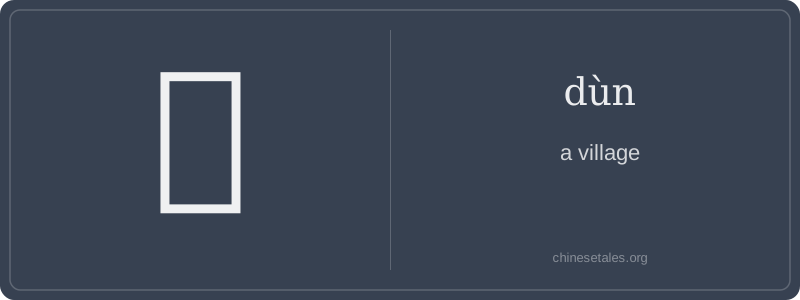
The earliest trace of 庉 appears not in oracle bones, but in Southern Song stele inscriptions and Yuan dynasty land deeds — where it emerges as a variant form of 屯 (tún), itself derived from an ancient pictograph of sprouting seeds planted in enclosed earth. The original 屯 depicted a seedling piercing soil with a curved root — symbolizing 'settlement through cultivation'. 庉 adds the 土 (tǔ, 'earth') radical at the bottom, making its meaning unmistakably locative: 'a place where earth is tamed and dwelled'. Visually, it evolved from a fluid, seal-script form — with a top component resembling 享 (xiǎng, 'to enjoy') — into today’s crisp structure: 享 over 土, suggesting 'shared earth' or 'earth held in common'.
This 'shared earth' idea anchored its classical usage: in the 16th-century *Jiangxi Gazetteer*, 庉 referred specifically to self-governing agrarian hamlets outside imperial administrative circuits — places where lineage elders, not magistrates, settled disputes. Poets like Tang Yin used it metaphorically: 'three cottages, one 庉' implied ethical sufficiency, not poverty. Over centuries, as centralized bureaucracy expanded, 庉 faded from official use — surviving only where geography preserved isolation: mountain valleys and river-island communities whose names still whisper it today.
First, let’s be honest: 庉 (dùn) is a linguistic ghost — it’s real, but nearly extinct. It means 'a village' or 'small settlement', carrying a quiet, rustic warmth, like the faint smoke curling from thatch roofs in old Jiangnan scrolls. Unlike common words like 村 (cūn) or 镇 (zhèn), 庉 feels archaic and poetic — you won’t hear it on subway announcements or in WeChat chats. Its core vibe is 'intimate, tucked-away human habitation', often implying isolation, simplicity, or historical continuity.
Grammatically, 庉 functions only as a noun — never a verb or adjective — and almost never stands alone. You’ll find it only in proper nouns (place names like 王家坉, Wángjiā Dùn) or literary compounds like 城坉 (chéng dùn, 'walled village'). Crucially, it cannot be pluralized with 们, nor modified directly by adjectives; instead, it’s always preceded by a modifier (e.g., 古坉 gǔ dùn, 'ancient village') or embedded in a toponymic phrase. Learners sometimes misread it as dùn (like 遁 'to flee') — but no: this is *dùn*, with the same tone as 盾 ('shield'), and zero relation to escape!
Culturally, 庉 survives almost exclusively in southern Chinese dialects (Hakka, Gan, and early Wu texts) and Ming–Qing local gazetteers. Modern Mandarin speakers rarely recognize it — even native teachers may pause and squint. That’s why mistaking it for 村 or 镇 is common: those are functional; 庉 is atmospheric. It’s not about utility — it’s about evoking a vanished world of earthen walls, narrow lanes, and communal wells. If you use it today, you’re not just naming a place — you’re quoting history.