庀
Character Story & Explanation
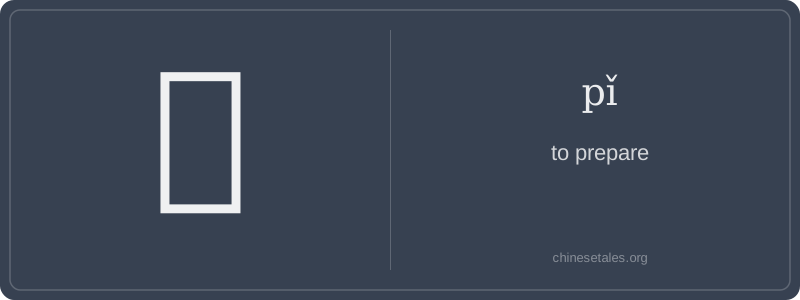
The earliest form of 庀 appears in bronze inscriptions as a compound pictograph: a broad roof radical (广) sheltering a simplified figure holding a tool — likely a chisel or measuring rod. Over time, the figure evolved into the right-hand component 丕 (pī), which itself originally depicted a person with a prominent head and extended arms — symbolizing ‘grand scale’ or ‘completeness’. The five-stroke modern shape crystallized by the Han dynasty: 广 (3 strokes) + 丕 (2 strokes), preserving both shelter and authoritative action.
This visual logic anchored its meaning: ‘to prepare under cover’ — i.e., to gather, arrange, and organize within a designated space or purpose. In the Zuo Zhuan, 庀 appears describing how Duke Wen of Jin ‘庀其官’ (pǐ qí guān) — ‘prepared his officials’, meaning he formally appointed and organized his administration. Later, in Tang poet Du Fu’s lines, ‘庀徒’ (pǐ tú) meant ‘engaging laborers’ — not hiring, but *assembling and assigning them*. The character never drifted into colloquial use; its form and function stayed tightly bound to intentionality, hierarchy, and tangible readiness.
Imagine you’re helping your grandmother prepare for the Spring Festival — not just tidying up, but *ritually assembling* everything: red couplets rolled just so, new tea sets arranged on lacquered trays, ancestral tablets dusted and centered. That deliberate, almost ceremonial act of ‘getting things ready with care’? That’s 庀 (pǐ). It’s not casual ‘preparing’ like 做饭 (cooking) or 安排 (scheduling); it’s precise, intentional, often physical arrangement — think laying out tools, setting up a ritual space, or organizing documents before an official submission.
Grammatically, 庀 is nearly always a verb in classical or literary contexts, rarely used alone in modern speech. You’ll find it in set phrases like 庀材 (pǐ cái — ‘to gather materials’) or 庀工 (pǐ gōng — ‘to engage workers’), where it implies *active procurement and organization*, not passive readiness. Learners often mistakenly use it like 准备 (zhǔnbèi), but 庀 carries weight — it suggests authority, responsibility, and completion of preparatory action. You wouldn’t say ‘我庀好了’; you’d say ‘已庀材待用’ (materials have been gathered and await use).
Culturally, 庀 echoes ancient bureaucratic and ritual precision — it appears in Tang dynasty administrative texts and Song-era construction records, always tied to official or ceremonial readiness. Modern learners rarely encounter it outside classical poetry, historical novels, or formal documents — which is why it’s absent from HSK. Mistake it for 已 (yǐ, ‘already’) or 丕 (pī, ‘great’), and you’ll derail both meaning and tone. Its rarity makes it a quiet marker of linguistic sophistication — like spotting a rare bird in a familiar park.