幵
Character Story & Explanation
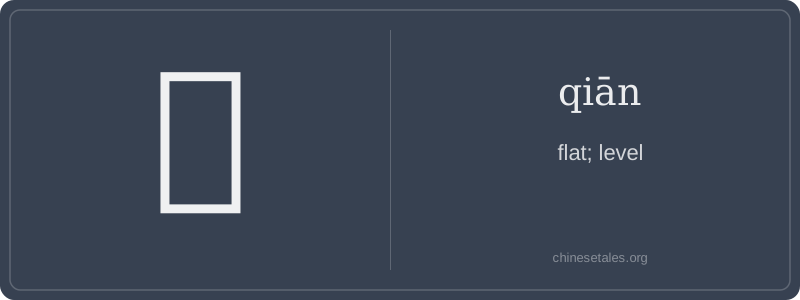
The earliest form of 幵 appears in oracle bone inscriptions as two parallel horizontal lines—no strokes, no radicals, just clean, unbroken bars floating in space. This wasn’t drawn with a brush but incised into bone or shell, evoking the horizon at dawn: calm, uninterrupted, utterly even. Over centuries, the lines thickened slightly in bronze script, then stabilized in seal script as two perfectly aligned, slightly tapered strokes—still strokeless in the strictest sense, since neither line connects to another or forms a closed shape. By the Han dynasty, clerical script rendered them with gentle curvature, preserving their serene duality—two lines refusing to converge, symbolizing equilibrium without hierarchy.
This visual minimalism became semantic precision: 幵 didn’t mean 'flat' as in 'boring', but 'flat' as in 'unobstructed', 'level' as in 'just'. In the *Book of Rites*, 幵 is used to describe the ideal ruler’s heart—'as level as a measuring plane'. Its very emptiness between the lines suggests openness: no barrier, no bias, no elevation. Unlike characters built from radicals or phonetic components, 幵 stands alone—a self-contained ideograph where form *is* meaning, and silence speaks louder than strokes.
Think of 幵 like the Chinese equivalent of the word 'level' in English—not just flat ground, but also 'level-headed', 'on equal footing', or even 'level playing field'. It’s a quiet, ancient word that whispers balance and evenness, not a shout. In classical texts, it often appears as an adjective meaning 'flat' (like terrain) or 'even' (like justice), but rarely stands alone in modern speech—it’s almost always tucked inside compound words or poetic phrases.
Grammatically, 幵 functions as a morpheme, not a free word: you won’t hear someone say 'This road is 幵!'—instead, it appears in words like 幵阔 (qiān kuò, 'vast and open') or 幵明 (qiān míng, 'clear-sighted; enlightened'). Its tone (first tone, qiān) is easy to confuse with 千 (qiān, 'thousand'), but unlike 千—which is everywhere—the character 幵 is a rare, elegant ghost: it survives only in literary or formal compounds, never in daily conversation or HSK vocabulary.
Culturally, 幵 carries Confucian resonance: 'level' implies fairness, impartiality, and harmony—qualities embedded in classical ideals of governance and personal cultivation. Learners often mistakenly assume it’s a simplified form of another character (it’s not) or try to use it as a standalone adjective (a native speaker would blink in confusion). Its rarity makes it a delightful 'deep cut'—like spotting a Renaissance fresco in a modern subway station: unexpected, meaningful, and quietly magnificent.