幰
Character Story & Explanation
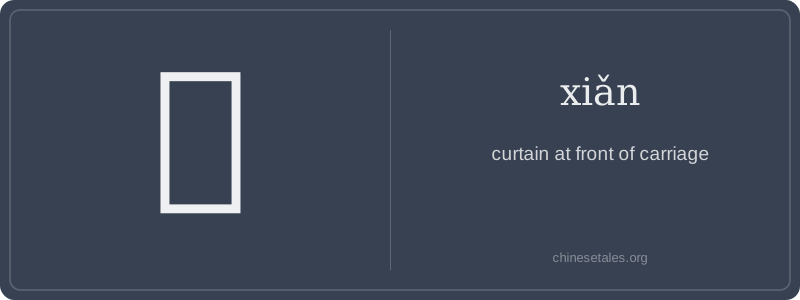
The earliest form of 幰 appears in Han dynasty clerical script, not oracle bones — it’s too late for that era. Its structure is telling: the top 宀 (mián, ‘roof’) encloses a simplified 顯 (xiǎn, ‘to display, make visible’), which itself evolved from a bronze inscription showing a person standing beneath the sun and eye (囧+頁). But here’s the twist: 幰 repurposes ‘display’ ironically — this curtain *hides*, yet its lavish materials (brocade, oilcloth, jade-tasseled silk) *announce* the occupant’s rank. Visually, it condensed from 顯’s full 23 strokes into a compact 10-stroke form: 宀 over 尸 (a stylized ‘body’ or ‘person’ shape) plus 彐 (a ‘hand-holding-brush’ variant), then further refined to today’s 尸 + 彐 under 宀.
In classical literature, 幰 appears in Du Fu’s poems describing imperial processions and in Tang-era travel diaries where ‘lifting the 幰’ signals arrival or readiness for audience. Its visual irony — using a component meaning ‘to reveal’ (from 顯) to denote something that conceals — reflects a deeper Daoist and Confucian tension: outward display of virtue versus inner reserve. Even the character’s pronunciation xiǎn echoes 顯, preserving that semantic wink: what is ‘shown’ is not the person, but their prestige — framed, filtered, and exquisitely draped.
Think of 幰 (xiǎn) as the ‘hood ornament meets Venetian blind’ of ancient Chinese transport — not a generic curtain, but the ornate, detachable front drape on elite horse-drawn carriages, like a silk windshield visor for Tang dynasty aristocrats. It’s poetic, rare, and functionally specific: never used for modern curtains (that’s 帘 or 幕), only in classical or literary contexts evoking elegance, seclusion, or ceremonial dignity. You’ll find it in poetry describing noble processions — not in your apartment lease.
Grammatically, 幰 is almost always a noun, typically appearing in compound nouns (e.g., 油幰, 翠幰) or as the object of verbs like 卷 (to roll up), 揭 (to lift), or 垂 (to hang down). It rarely stands alone in speech; you’d say ‘the oilcloth 幰 was lowered’ (油幰垂落), not ‘there is a 幰’. Learners mistakenly try to use it like 窗帘 (curtain), but doing so sounds like quoting Li Bai at a IKEA checkout — charming, but wildly out of place.
Culturally, 幰 embodies ‘conspicuous concealment’: a luxury that both displays status and shields privacy. Its near-total absence from spoken Mandarin and HSK lists means encountering it is like spotting a phoenix feather — thrilling, archaic, and best appreciated with historical context. The biggest pitfall? Confusing its ‘wind + roof’ top (宀) with characters meaning ‘to show’ or ‘easy’ — but 幰 isn’t about visibility or simplicity; it’s about deliberate, graceful veiling.