幯
Character Story & Explanation
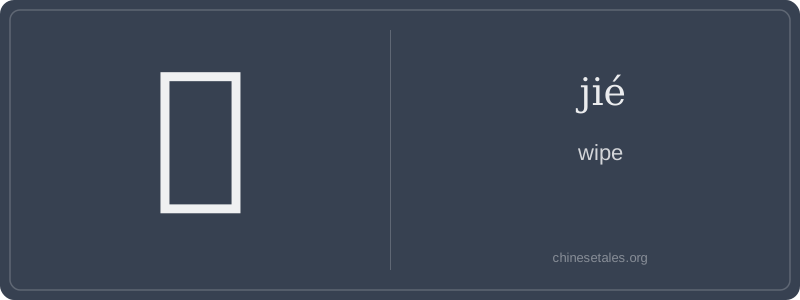
The earliest form of 幯 appears in bronze inscriptions as a pictograph showing a hand holding a cloth or brush hovering over a surface — not wiping sideways, but pressing down and lifting *away*. The top component evolved from a stylized representation of 'cloth' or 'sponge', while the bottom was originally a simplified depiction of 'surface' or 'ground'. Over centuries, the upper part condensed into the modern 羊 (yáng) shape — not meaning 'sheep', but a phonetic loan that stabilized pronunciation — while the lower part hardened into the 用 (yòng) radical, ironically suggesting 'use' but historically anchoring the idea of *purposeful application*.
By the Han dynasty, 幯 had shifted from literal physical wiping to metaphorical cleansing — seen in texts like the *Book of Rites*, where it describes ritual purification: '以帛幯面' (wiping the face with silk to remove impurity before sacrifice). Its semantic range expanded to include elimination of shame, error, or guilt, cementing its association with moral and administrative finality. Even today, its visual structure — a hand (implied) acting decisively upon a surface — mirrors its linguistic role: no half-measures, no residue.
Think of 幯 (jié) not as a humble 'wipe' like wiping a table, but as the decisive, almost surgical act of erasing — like a film director shouting 'Cut!' and instantly removing a flawed take from existence. In Chinese, it carries weight: it’s not casual cleaning but intentional removal — of stains, records, evidence, or even abstract things like shame or debt. You’ll rarely hear it in daily chatter (hence its absence from HSK), but it appears with gravity in literature, legal texts, and classical idioms.
Grammatically, 幯 functions primarily as a verb, often with a direct object and sometimes paired with aspect particles like 了 or 过. It frequently appears in compound verbs like 幯去 (jié qù, 'wipe away') or 幯净 (jié jìng, 'wipe clean'), where the nuance is *thorough removal*, not just surface-level cleaning. Learners mistakenly use it like 擦 (cā) — which means 'to wipe lightly' (e.g.,擦桌子) — but 幯 implies force, finality, and consequence: you don’t 幯 your glasses; you 幯 a scandal from the record.
Culturally, 幯 echoes Confucian ideals of moral purity and historical accountability — to 幯 one’s name is to clear one’s reputation, while to 幯史 (jié shǐ) is to erase history itself, a deeply loaded act. A common learner trap is overusing it in spoken contexts; native speakers reserve it for literary, rhetorical, or solemn registers — using it casually sounds archaic or sarcastically dramatic, like saying 'I shall efface this coffee stain' instead of 'I’ll wipe it off.'