幮
Character Story & Explanation
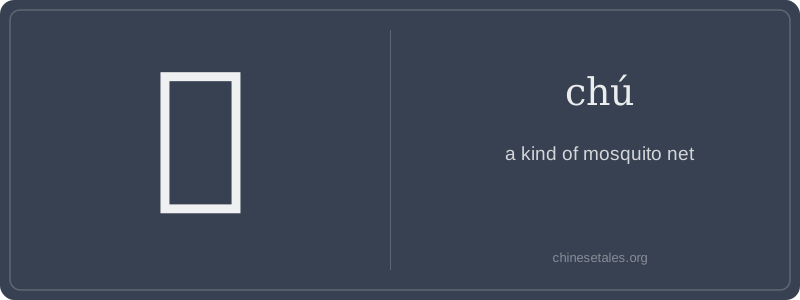
The earliest form of 幮 appears in bronze inscriptions of the late Zhou dynasty — not as a pictograph of a net, but as a compound ideograph: the top part 亠 (tóu, ‘cover’) + the bottom part 余 (yú, originally a pictograph of a house with surplus grain, later repurposed phonetically). Over centuries, the lower component simplified from 余 to 予, then further stylized into the modern 幮’s distinctive ‘dot above crossed strokes’ base. Crucially, the character was never drawn as mesh — its visual logic is *coverage from above*, not interlacing threads.
This ‘covering’ concept anchored its meaning: by the Han dynasty, 幮 referred specifically to bed canopies used in elite households, often mentioned alongside ‘silken curtains’ and ‘scented incense’ in fu-rhapsodies. The Book of Rites (Lǐjì) notes that ‘a proper resting place requires a chú to shield life-breath from nocturnal pests’ — linking it to qi-protection philosophy. Its decline began in the Ming–Qing era, as cotton mosquito nets became widespread and the more colloquial 蚊帐 (wén zhàng) displaced 幮 in daily use — though poets kept 幮 alive for its elegant brevity and classical resonance.
Imagine a sweltering summer night in an old Jiangnan courtyard: fireflies blink, cicadas hum, and Grandmother carefully unfurls a delicate, ivory-colored net over the sleeping platform — not to trap anything, but to guard against mosquitoes. That net is a chú, and the character 幮 evokes precisely that image: fine, suspended, protective, and quietly essential. It’s not just any net — it’s a *bed* mosquito net, historically made of silk or finely woven gauze, hung from a ceiling frame. This isn’t a generic word for ‘net’ (that’s 网 wǎng); 幮 carries connotations of domestic care, intimacy, and seasonal ritual.
Grammatically, 幮 is a noun — almost always used with measure words like 一顶 (yī dǐng, ‘one canopy-style item’) or 一张 (yī zhāng, ‘one flat sheet-like item’). You’ll rarely see it alone; it appears in phrases like 蚊帐 (wén zhàng) — where 幮 is the archaic literary variant of 帐 (zhàng, ‘curtain/tent’). In modern usage, 幮 is nearly obsolete in speech, surviving mainly in classical poetry, historical novels, or regional dialects (e.g., Wu Chinese), so learners won’t hear it on the street — but spotting it in a Tang poem or Qing dynasty novel signals deep cultural texture.
Culturally, 幮 reflects pre-modern hygiene and aesthetics: mosquito nets were status objects — embroidered, perfumed, and sometimes even inscribed with auspicious characters. A common mistake is misreading 幮 as 厨 (chú, ‘kitchen’) due to identical pronunciation — but they share no semantic or etymological link! Also, don’t confuse it with 幕 (mù, ‘curtain’): while both hang, 幮 is specifically *bed-protective*, whereas 幕 is theatrical, military, or ceremonial.