帼
Character Story & Explanation
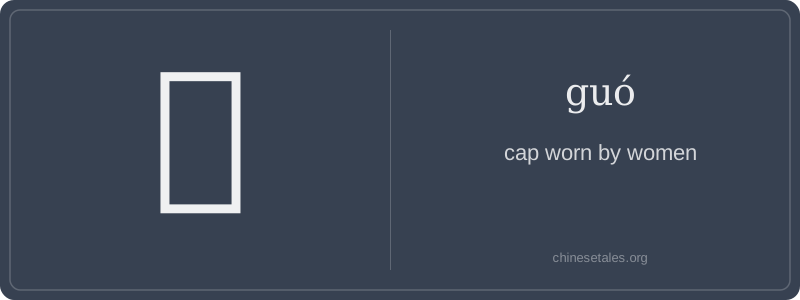
The earliest form of 帼 appears in Han dynasty clerical script, not oracle bone — it’s too late for Shang inscriptions. Visually, it’s a brilliant fusion: the left side 巾 (jīn) — a pictograph of a hanging cloth or towel — anchors the meaning of textile-based headgear; the right side 国 (guó, 'country') isn’t phonetic coincidence — it’s a deliberate visual pun. In ancient ritual, elite women’s headdresses were emblems of familial 'territory': their virtue and influence defined the moral 'boundaries' of the household, much like a sovereign ruled a state. So 国 here symbolizes symbolic sovereignty, not sound.
Over centuries, the character stabilized into its current 11-stroke form: 巾 (3 strokes) + 国 (8 strokes). In texts like the *Book of Rites* (Lǐjì), 帼 appears in descriptions of wedding attire for noble brides; Sima Qian’s *Records of the Grand Historian* uses it metaphorically for women who ‘govern’ through wisdom. The character never meant 'national flag' — that’s 旗 (qí). Its enduring power lies in how a single glyph fused fabric, femininity, and authority — turning cloth into crown.
Think of 帜 as a quiet relic — not a daily word, but a poetic whisper from ancient China’s textile world. Its core meaning is a specific kind of headwear: a ceremonial cap or headdress worn by elite women in pre-Qin and Han dynasties, often made of silk and adorned with ribbons or jade. It’s not just 'hat' — it evokes elegance, ritual status, and gendered sartorial hierarchy. You’ll almost never hear it in spoken Mandarin today; it lives in classical poetry, historical novels, and formal titles like '巾帼英雄' (heroic women), where it’s fossilized in fixed idioms.
Grammatically, 帼 functions only as a noun, always embedded in compounds — never standalone in modern usage. Learners sometimes try to use it like 帽 (mào, 'hat') or 头巾 (tóujīn, 'headscarf'), but that’s a classic blunder: 帼 implies aristocratic femininity and antiquity, not practical head coverings. It appears in subject position ('巾帼不让须眉') or as a modifier ('帼饰华美'), but never with measure words like 一顶 or 一个 — its grammar is frozen in literary time.
Culturally, 帼 carries quiet feminist weight: though archaic, it’s the root of '巾帼' — a term that reframes female strength as dignified, skilled, and culturally authoritative. Mistake it for 巾 (jīn, 'towel') or 国 (guó, 'country'), and you’ll conjure absurd images — like 'a towel wearing a woman' or 'a country on her head'. Its rarity makes it a linguistic time capsule: handle it with reverence, not utility.