幔
Character Story & Explanation
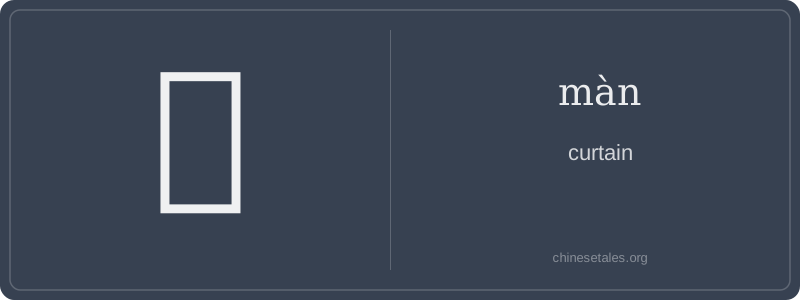
The earliest form of 幔 appears in seal script (around 200 BCE), where it already combined 巾 (jīn, ‘cloth’) on the left with 蔓 (màn, ‘creeping vine’) on the right — not as a botanical reference, but as a phonetic loan. The original oracle bone inscriptions didn’t feature 幔; it emerged later as a specialized character for luxurious hanging textiles. Its 14 strokes crystallized in clerical script: the 巾 radical anchors it in fabric, while the 蔓 component — with its winding, looping strokes (艹 + 艸 + 曼) — visually mimics the cascading folds and tassels of a rich, draped curtain.
By the Tang and Song dynasties, 幔 had become synonymous with ceremonial cloths — especially in theater and temple rituals. In the Ming dynasty novel *Jin Ping Mei*, 幔 appears repeatedly to mark intimate or secretive spaces: ‘青纱幔垂地’ (qīng shā màn chuí dì, ‘blue gauzy 幔 hung to the floor’) suggests both opulence and veiled privacy. The character’s visual rhythm — vertical 巾 grounding horizontal, flowing strokes of 蔓 — mirrors how a real 幔 behaves: anchored yet fluid, modest yet commanding. It’s cloth made architectural.
At its heart, 幔 (màn) isn’t just ‘curtain’ — it’s a curtain with presence: heavy, decorative, and deliberately theatrical. Think stage curtains in Peking opera, not your IKEA bedroom drape. Native speakers use it almost exclusively for formal, suspended, or ornamental hangings — often evoking grandeur, concealment, or ritual transition. You won’t hear it for shower curtains (that’s 浴帘 yùlián) or roller blinds (卷帘 juǎnlián); 幔 implies weight, artistry, and intentionality — like the velvet drop before a symphony begins.
Grammatically, 幔 is almost always a noun, rarely used alone. It appears in compound nouns (e.g., 帷幔 wéimàn) or as the object of verbs like 拉开 (lā kāi, 'pull open'), 放下 (fàng xià, 'lower'), or 悬挂 (xuánguà, 'hang'). Crucially, it’s not a measure word nor a verb — a common learner error is trying to say *'màn le'* ('curtained') as if it were an action verb. It doesn’t conjugate; it hangs — literally and linguistically.
Culturally, 幔 embodies Chinese spatial philosophy: boundaries that are soft, temporary, and meaningful — not walls, but thresholds. In classical poetry and drama, drawing back the 幔 signals revelation or fate unfolding. Learners often overgeneralize it from English ‘curtain’; remember: if it’s functional, lightweight, or modern (like a café string curtain), there’s almost certainly a better, more precise word. 幔 is reserved for moments that deserve a pause — and a bow.