幏
Character Story & Explanation
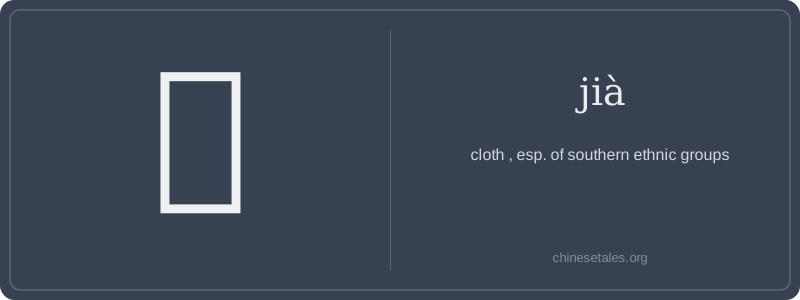
The earliest form of 幏 appears in Han dynasty seal script, not oracle bones — it’s relatively young for a Chinese character. Its left radical 纟 (sī, silk/cloth) anchors it firmly in the textile family, while the right component 賈 (gǔ, merchant) wasn’t just decorative: it phonetically approximated the local Zhuang pronunciation *ka* for ‘woven cloth’, and subtly signaled trade — these cloths were bartered across mountain passes for salt and iron. Over centuries, 賈 simplified to 贾 (same sound, fewer strokes), and the whole character stabilized into today’s 幏: two clear visual halves — ‘cloth’ + ‘merchant’, telling a story of exchange and cultural circulation.
By the Ming and Qing dynasties, 幏 appeared in local gazetteers describing tribute cloth sent from southern prefectures to the imperial court. Unlike classical terms like 素 (sù, plain silk) or 練 (liàn, boiled silk), 幏 never entered literary poetry — it stayed grounded in administrative and ethnographic texts. Its shape is a deliberate bridge: the silk radical says ‘this is textile’, while 贾 says ‘this is traded, named, and recognized beyond its village’. Even today, when linguists reconstruct ancient Zhuang words, 幏 is one of the few characters whose phonetic component reliably points back to pre-Sinitic roots.
Forget 'cloth' as generic fabric — 幏 (jià) is a cultural artifact in character form. It specifically evokes handwoven, plant-dyed textiles from Zhuang, Dong, and Yao communities in Guangxi and Guizhou: indigo batik, embroidered brocades, and ceremonial banners that tell ancestral stories. This isn’t IKEA cotton — it’s cloth with memory, identity, and ritual weight. You’ll almost never see it in daily Mandarin speech; it lives in ethnographic reports, museum labels, and academic papers on intangible cultural heritage.
Grammatically, 幏 functions exclusively as a noun — never a verb or adjective — and nearly always appears in compound nouns or descriptive phrases like 'zhuàng zú fāng jià' (Zhuang ethnic group’s patterned cloth). Learners sometimes misread it as a variant of 布 (bù, general 'cloth') or try to use it independently ('This is 幏'), but it’s too specialized for that. Think of it like the English word 'tartan' — precise, culturally anchored, and never used alone without context ('This is tartan' sounds odd; 'Scottish tartan' feels right).
Culturally, 幏 carries quiet political resonance: its revival in official discourse signals China’s recognition of minority textile arts as national treasures. A common pitfall? Assuming it’s interchangeable with 絲 (sī, silk) or 棉 (mián, cotton) — but 幏 isn’t about material; it’s about origin, technique, and ethnicity. If you see it in print, pause: you’re not reading about fabric — you’re reading about sovereignty woven thread by thread.