帏
Character Story & Explanation
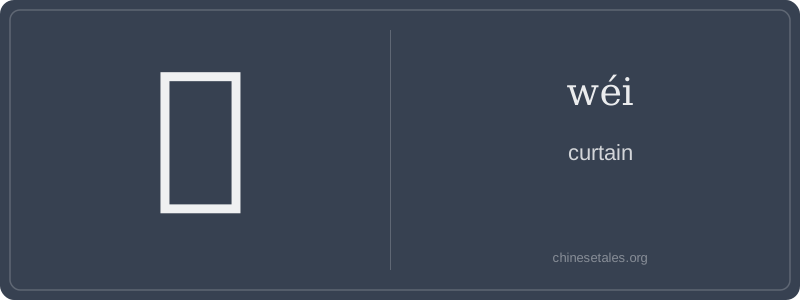
The earliest form of 帏 appears in Warring States bamboo slips as a combination of 巾 (a hanging cloth) and 隹 (a short-tailed bird), suggesting something light, fluttering, and suspended — not heavy drapery, but fine, airy fabric stirred by breeze. Over centuries, the bird (隹) simplified into the top component we see today: two horizontal strokes, a dot, and a slanted stroke — all evoking feathers in motion. Meanwhile, the radical 巾 stayed firmly at the bottom, anchoring the meaning in textile. By the Han dynasty, the character stabilized into its current 7-stroke form: three strokes above (the abstracted bird), then four for 巾 — elegant, balanced, and unmistakably textile-rooted.
This visual evolution mirrors its semantic journey: from literal 'light hanging cloth' to a symbol of refined seclusion. In the Classic of Poetry (Shījīng), 帏 appears in odes describing bridal chambers — 'her silken 帏 hung low, her virtue high'. Later, in Cao Xueqin’s Dream of the Red Chamber, 罗帏 (luó wéi) recurs as both setting and metaphor: the curtain isn’t just decor — it’s the fragile membrane between desire and decorum, visibility and virtue. Its shape still whispers 'lightness'; its usage still insists on dignity.
Think of 帏 (wéi) not as just 'curtain' in the IKEA sense, but as a soft, elegant barrier — one that veils, separates, and dignifies. In classical Chinese, it’s never a plastic shower curtain or a stage backdrop; it’s the fine silk drape drawn around a noblewoman’s bedchamber, or the ceremonial cloth shielding imperial consorts from public view. The character breathes quiet authority: it’s always a noun, never a verb, and almost never used alone — you’ll nearly always see it in compounds like 纱帏 (shā wéi, gauzy curtain) or 罗帏 (luó wéi, brocade curtain). It carries poetic weight, not practical utility.
Grammatically, 帏 behaves like a refined, slightly archaic noun — think of it as the 'velvet rope' of Chinese vocabulary. You won’t say *wǒ kāi le wéi* ('I opened the curtain'); instead, it appears in descriptive, literary, or historical contexts: 'the moonlight filtered through the gauzy 帏', or 'she sat behind the embroidered 帏'. Learners often mistakenly substitute it for 幕 (mù, screen/curtain) or 帘 (lián, blind/drape), but those are neutral or functional — 帏 is inherently delicate, intimate, and hierarchical.
Culturally, 帏 evokes gendered space and ritual modesty: in Tang poetry and Ming novels, it marks the boundary between inner (nèi) and outer (wài) realms — where women moved, spoke, and were seen. Mistake it for a generic 'curtain', and you’ll miss its whisper of silk, seclusion, and social code. Also beware: its 7 strokes include a deceptively simple '巾' radical — but the top part isn’t '韦' (wéi, leather); it’s a stylized '隹' (zhuī, short-tailed bird) turned abstract! That ‘bird’ shape hints at lightness and movement — like fluttering fabric.