帧
Character Story & Explanation
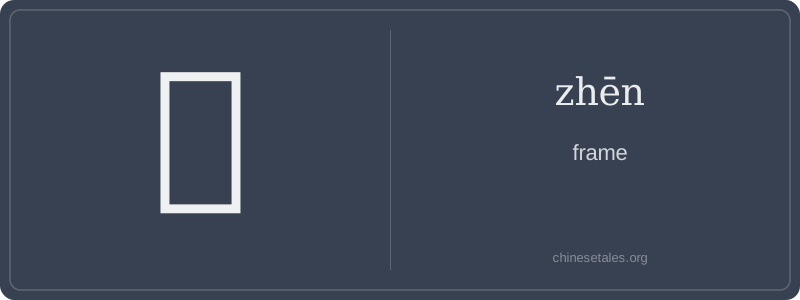
帧 has no oracle bone or bronze script ancestry — it’s a latecomer, invented during the Ming-Qing transition as a variant of 眞 (now simplified as 真). The earliest form appeared in Song dynasty dictionaries as a rare phonetic borrowing, written with 巾 on the left (a common phonetic component for zhēn-sounding characters) and 贞 (zhēn) on the right. Over centuries, 贞 simplified to 贞 → then to the modern 贞-like shape above, while 巾 stabilized as the left-hand radical — though it contributes only sound, not meaning. The nine strokes lock in cleanly: three horizontal strokes in the top ‘贞’ part, then the vertical and folds of 巾 below — a compact, balanced glyph built for speed, not symbolism.
The meaning shift is brilliantly pragmatic: from 眞 (‘truth’, ‘authenticity’) to 帧 (‘discrete unit’) reflects how Chinese repurposes characters for new tech. Early telegraph engineers needed a term for ‘a unit of transmission’, and since 眞 sounded right and looked stable, they swapped the ‘eye’ radical 目 for 巾 — creating 帧. By the 1950s, it was standard in film manuals and radar specs. There’s *no* classical literary usage — not one line in the Four Books or Tang poetry uses 帧. Its entire life is digital, disciplined, and deliberately unromantic.
Think of 帧 (zhēn) not as a dusty dictionary word, but as a quiet digital heartbeat — the smallest unit that holds a moment still. In Chinese, it’s almost exclusively technical: a single image in a video sequence, a data packet in networking, or a memory 'frame' in computing. Unlike English 'frame', which can be physical (a picture frame) or abstract (a frame of mind), 帧 is stubbornly functional and modern — you’ll never see it in poetry or classical texts. It carries zero emotional weight; its job is precision, not poetry.
Grammatically, 帧 is a measure word *only* for digital/technical units — never for photos, paintings, or windows. You say 一帧画面 (yī zhēn huàmiàn, 'one video frame'), not 一帧照片. It pairs with verbs like 播放 (bōfàng, 'to play'), 截取 (jiéqǔ, 'to capture'), or 丢帧 (diū zhēn, 'to drop frames'). Learners often mistakenly use it where 个 or 张 would fit — but no: 帧 is a specialist, not a generalist.
Culturally, 帧 is a linguistic fossil of China’s rapid tech adoption: it was rarely used before the 1980s, then exploded with TV broadcasting, early computer graphics, and now AI video generation. A fun trap? Its radical 巾 (jīn, 'cloth') has *nothing* to do with cloth — it’s purely phonetic here! Students waste time imagining fabric frames. Truth is: this character was borrowed for sound (zhēn rhymes with 真 zhēn 'true'), not meaning — a classic case of 'sound-over-sense' adaptation in technical vocabulary.