帹
Character Story & Explanation
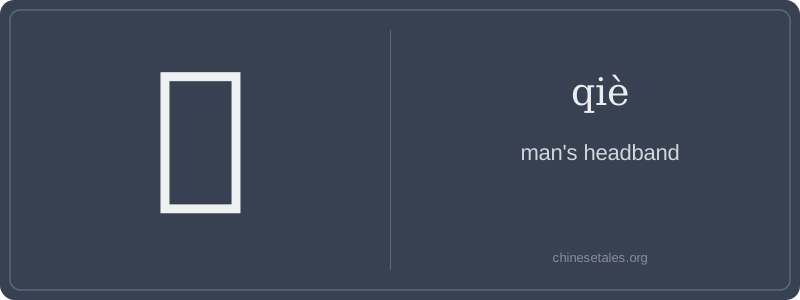
The earliest form of 帹 appears in bronze inscriptions of the Western Zhou dynasty (c. 1046–771 BCE) as a stylized pictograph: two parallel horizontal lines (representing folded silk bands) above a simplified head glyph (-like shape), with vertical strokes suggesting ties securing it behind the ears. Over centuries, the head element eroded into the top component 亠 (a roof-like radical), while the band became the lower part — eventually standardizing into the modern 帹, where the left radical 丿 (piě, 'slash') hints at the downward drape of the band’s ends, and the right side 夋 (qūn) evolved from an ancient phonetic component unrelated to meaning.
By the Warring States period, 帹 was codified in ritual texts like the Zhou Li (Rites of Zhou) as essential attire for scholars performing ancestral rites or receiving instruction. Mencius references ‘正帹端冕’ (zhèng qiè duān miǎn, 'adjusting the headband and wearing the formal cap') to symbolize moral readiness. The character’s visual austerity — minimal strokes, no flourishes — mirrors its function: unobtrusive, precise, dignified. Even in Tang poetry, a single mention of 帹 instantly conjures the image of a scholar kneeling before bamboo scrolls, his headband taut, his thoughts aligned — a perfect fusion of form, function, and philosophy.
Think of 帹 (qiè) as China’s ancient equivalent of a Greek laurel wreath or a Roman senator’s fillet — not mere cloth, but a subtle marker of status, ritual propriety, and scholarly identity. In classical Chinese, it specifically denoted a narrow, stiffened headband worn by men of rank during ceremonies or formal study — not a hat, not a cap, but a deliberate band of silk or hemp tied just above the forehead. Unlike modern clothing terms like 帽子 (mào zi, 'hat'), 帹 carries quiet elegance and restraint: it’s never casual, never decorative for its own sake.
Grammatically, 帹 is almost exclusively a noun — and a rare one at that. You won’t find it in spoken Mandarin today; it lives only in literary texts, historical reenactments, or poetic allusions. It appears bare (e.g., ‘束帹’ shù qiè, 'to fasten the headband') or in compound nouns, never as a verb or adjective. Learners sometimes misread it as a variant of 切 (qiē, 'to cut') due to identical pronunciation — but there’s zero semantic link. And crucially: it’s *not* used for women’s headwear (that’s 髻 jì or 钗 chāi); this distinction matters deeply in classical gendered dress codes.
Culturally, 帹 evokes the Confucian ideal of outward composure reflecting inner cultivation — the headband literally holds the hair (and thus the mind) in disciplined order. A common mistake? Assuming it’s interchangeable with 巾 (jīn, 'towel/cloth'); while both involve fabric, 巾 is generic and functional, whereas 帹 is ritual-specific and hierarchical. Its rarity means even native speakers may hesitate — making it a delightful ‘deep cut’ for learners who want to read Zhuangzi or Tang poetry authentically.