帣
Character Story & Explanation
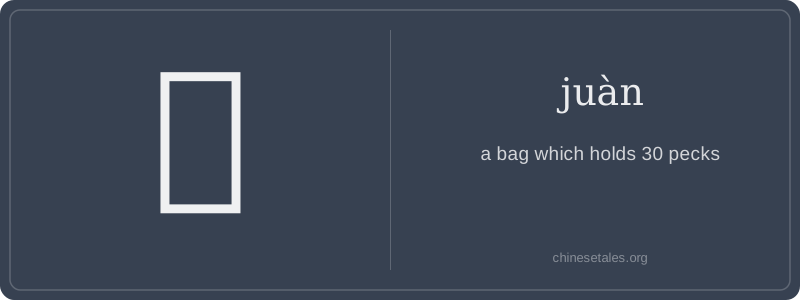
The earliest form of 帣 appears on Warring States bamboo slips — not as a pictograph, but as a phonosemantic compound. Its left side, 巾 (jīn), means ‘cloth’ or ‘towel’, clearly signaling its material origin: a woven sack. Its right side, 捲 (juǎn, an old variant of 卷), was borrowed purely for sound — but crucially, *not* for meaning. Over centuries, 捲 simplified to 倦’s right component, then further stylized into the modern 帣 shape. There’s no ‘rolling’ action encoded here — just a phonetic placeholder that drifted visually while retaining its ancient pronunciation juàn.
This character never appeared in oracle bones or bronze inscriptions; it emerged later, during the standardization of weights and measures under Qin and early Han. In the Book of Rites (Lǐjì) and Shuōwén Jiězì dictionary (121 CE), 帣 is defined strictly as ‘a cloth sack holding thirty dǒu’. Its usage remained frozen in administrative jargon — no poets used it metaphorically, no idioms adopted it. Unlike characters that evolved semantically (e.g., 道 from ‘road’ to ‘philosophical path’), 帣 stayed stubbornly literal: a calibrated sack, a bureaucratic unit, a silent witness to China’s granary-state origins.
Let’s be honest: 帣 (juàn) is a ghost character — it haunts classical texts but rarely shows up in modern speech or writing. It doesn’t mean ‘bag’ in the everyday sense; it’s a precise, archaic unit of measurement: a cloth sack holding exactly 30 pecks (dǒu) of grain — roughly 300 liters! Think of it as ancient China’s standardized shipping pallet: not just any bag, but a *certified* capacity vessel used for tax collection and granary logistics. Its feel is bureaucratic, agrarian, and deeply historical — you’ll encounter it only in pre-Qin or Han dynasty records, never in HSK textbooks or WeChat chats.
Grammatically, 帣 functions exclusively as a measure word for bulk grain — but unlike common measure words like gè or tiáo, it’s *only* used in formal, quantitative contexts with numerals and nouns like lì (millet) or shǔ (beans). You’d never say ‘yī 帣 mǐ’ (one juàn of rice) today — it’s obsolete. Instead, you’ll see it in phrases like ‘sān 帣 lì’ in bamboo-slip inscriptions. No verbs attach to it; no adjectives modify it. It stands alone, stoic and numeric.
Culturally, 帣 reveals how meticulously early Chinese states managed food security — every grain counted, every sack calibrated. Learners often misread it as juǎn (‘to roll’) due to the sound, or confuse it with 卷 (juǎn/juàn), which *does* mean ‘scroll’ or ‘roll’. But 帣 has zero connection to rolling — it’s about volume, not motion. The biggest mistake? Assuming it’s still usable. It’s not. Treat it like a museum artifact: fascinating to study, useless to order takeout with.