帟
Character Story & Explanation
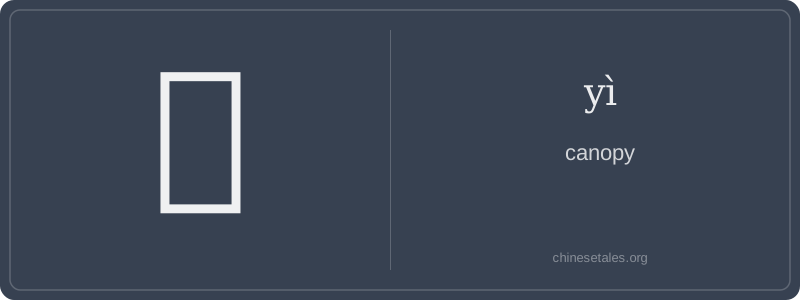
The earliest form of 帟 appears in Warring States bamboo slips—not oracle bones—as a compound ideograph: the top half is 幂 (mì), a variant of 幕 (mù, ‘curtain’), originally depicting cloth draped over a frame; the bottom is 巾 (jīn, ‘cloth’), reinforcing textile material. Over centuries, 幂 simplified into the top component we see today—three horizontal strokes (一) representing layers of silk, a vertical stroke (丨) for the central suspension pole, and two diagonal strokes (丿 and 丶) suggesting tassels or hanging cords. The lower 巾 retained its full four-stroke form, grounding the character in fabric.
By the Han dynasty, 帟 was codified in ritual texts like the Rites of Zhou (《周礼》) as one of five official canopies—each color and shape denoting rank: yellow 帟 for the Son of Heaven, red for feudal lords. Its meaning never drifted toward ‘roof’ or ‘shelter’; instead, it narrowed into a technical term for ceremonial overhead textiles used exclusively in state rites, ancestral worship, and imperial processions. The visual austerity of its structure—balanced, symmetrical, textile-rooted—mirrors its function: a silent, elegant assertion of cosmic and political order.
Imagine you’re at a Tang dynasty imperial banquet—golden wine cups gleam, musicians tune their pipas, and above the emperor’s throne hangs a magnificent silk canopy: not just decorative, but a sacred symbol of celestial authority and hierarchical order. That canopy is a yì (帟). This isn’t your garden-party tent—it’s a formal, ritual-grade canopy, usually square, suspended over thrones, altars, or ceremonial chariots. In classical Chinese, 帟 appears almost exclusively in formal, literary, or historical contexts—not daily speech—and functions as a noun, never a verb or adjective. You’ll find it in phrases like ‘帟幕’ (yì mù), where it modifies ‘curtain’ to mean ‘ritual canopy-curtain,’ never standalone like ‘tent’ in English.
Grammatically, 帟 is a high-register monosyllabic noun that resists modern colloquial usage. Learners often mistakenly treat it like 棚 (péng, ‘shed’) or 帐 (zhàng, ‘tent’), but 帟 carries no connotation of shelter or utility—it’s purely symbolic, almost liturgical. You’d never say ‘I set up a 帟’; you’d read about one being ‘suspended over the ancestral tablet’ in a Ming-era stele inscription. Its tone (yì, fourth tone) rhymes with ‘easy’—a helpful auditory anchor—but don’t let that fool you: this character is anything but easy to use naturally.
Culturally, 帟 evokes the Confucian cosmology of vertical harmony: heaven above, ruler below, all mediated by ritual objects. Mistaking it for a generic ‘canopy’ risks flattening its layered significance—it’s less about shade and more about sovereignty made visible. Modern writers use it sparingly, often for poetic or archaic flavor—like naming a luxury hotel’s grand foyer ‘帟庭’ (yì tíng) to evoke imperial elegance. If you encounter it outside classical texts or museum labels, pause: it’s likely deliberate stylistic antiquing.