帛
Character Story & Explanation
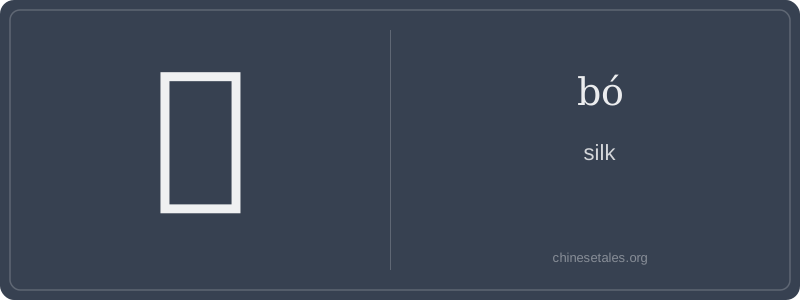
The earliest form of 帛 appears on Warring States bamboo slips as a composite: left side 巾 (a stylized hanging cloth), right side 白 (bái, 'white') — not as color, but as a phonetic clue (ancient pronunciation of 白 was closer to *bâk, matching 帛’s bó). Oracle bone inscriptions don’t show it; it emerged later as writing moved to silk. The modern form crystallized by the Qin dynasty: 巾 (3 strokes) + 白 (5 strokes) = 8 strokes total — clean, balanced, and deliberately refined, mirroring silk’s smooth drape.
By the Han dynasty, 帛 wasn’t just fabric — it was memory technology. The Mawangdui tombs yielded silk manuscripts where 帛 literally held cosmology, medicine, and maps. In the Shuōwén Jiězì, Xu Shen defines it as 'fine white cloth for writing' — emphasizing purity and purpose. Its visual duality — cloth (巾) + 'white' (白) — reflects its role: blank, luminous, and dignified. Even today, calling something a 帛卷 (bó juǎn) implies reverence — not just 'scroll', but 'sacred scroll'.
Think of 帛 (bó) as the 'linen' of ancient China — not just any fabric, but silk: luxurious, rare, and loaded with status. Unlike English 'silk', which feels smooth and neutral, 帛 carries quiet gravitas — it’s the material of imperial decrees, ancestral banners, and Daoist talismans. You won’t hear it in daily chatter ('I bought silk scarves' uses 丝 instead), but you’ll see it in museum labels, classical poetry, or historical dramas whispering 'scrolls of white 帛' — always poetic, never casual.
Grammatically, 帛 is a noun-only character, almost never used alone. It appears in compounds (like 帛书 or 素帛) and rarely takes measure words — you’d say 一卷帛 (yī juǎn bó, 'one scroll of silk'), not *一条帛. Learners often mistakenly substitute it for 丝 (sī, 'silk thread/fiber') or try to use it like a modern countable noun — a red flag! It’s fossilized elegance, not functional vocabulary.
Culturally, 帛 evokes Han dynasty bamboo-and-silk manuscripts — where bamboo strips held routine records, but precious silk reserved sacred texts like the Mawangdui Dao De Jing. Mistaking 帛 for 丝 is like confusing parchment with printer paper: same function, wildly different weight. And yes — its radical 巾 (jīn, 'towel/cloth') anchors it firmly in the textile family, but its eight-stroke elegance signals 'this cloth is ceremonial, not laundry.'