帕
Character Story & Explanation
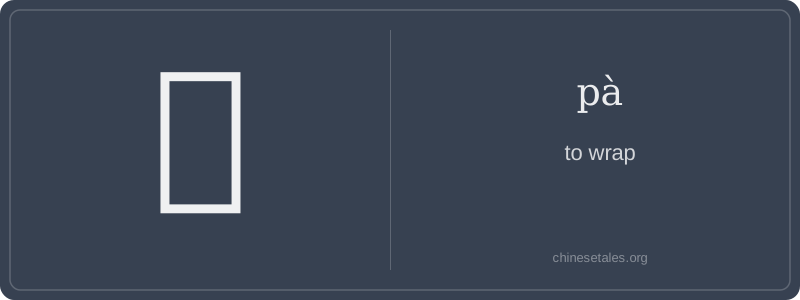
The earliest form of 帕 appears in Warring States bamboo slips as a clear pictograph: a vertical cloth radical 巾 on the left, paired with a simplified glyph resembling a hand holding folded cloth — not 白 yet, but a curved line suggesting layers being tucked. Over centuries, the right-hand element stylized into 白, likely because scribes found its clean, symmetrical shape easy to write quickly and because its ancient pronunciation (*brâk*) closely matched the verb’s sound. By the Han dynasty, the eight-stroke structure we know today was fixed: three horizontal strokes in 巾 (representing woven threads), then 白’s distinctive 'eye-in-a-box' shape — a visual echo of cloth neatly folded and secured.
This evolution mirrors its semantic narrowing: originally a general term for 'covering with cloth', 帕 gradually shed broader meanings to specialize in gentle, intentional wrapping — especially of medicinal or sacred items. In the 12th-century medical classic 《太平惠民和劑局方》, 帕 appears in instructions like '以絹帕之' ('wrap it in silk cloth'), emphasizing material specificity and ritual care. The character’s compact form — just eight strokes — belies its weight: each stroke is a reminder that in traditional Chinese practice, how you cover something matters as much as what you cover.
At its heart, 帕 (pà) is a quiet verb meaning 'to wrap' — but not the grand, ceremonial wrapping of gifts or dumplings. Think intimate, tactile, almost tender: folding cloth around something fragile, like swaddling a newborn or bundling herbs in a cloth pouch. Its radical 巾 (jīn) — 'cloth' — anchors it firmly in textile action, and the right side 白 (bái, 'white') isn’t about color here; it’s a phonetic clue that once sounded closer to *pà* in Old Chinese, helping learners pronounce it while subtly reinforcing purity or softness of fabric.
Grammatically, 帕 is rare as a standalone verb in modern Mandarin — you won’t hear 'I wrap' as *wǒ pà* in daily speech. Instead, it appears almost exclusively in compound verbs like 包帕 (bāo pà, 'to wrap up tightly') or in classical poetry and medical texts describing herbal preparations. Learners often mistakenly treat it like 包 (bāo, 'to wrap/enclose') — but 帕 implies gentleness, precision, and cloth-based containment, never broad enclosure or metaphorical 'wrapping' like 'wrapping your head around an idea.'
Culturally, 帕 lives in the margins — in TCM prescriptions ('wrap the herbs in gauze'), in regional folk rituals (wrapping amulets in red cloth), and in poetic diction where rhythm and texture matter more than utility. Its absence from HSK reflects how deeply specialized its usage is: it’s not for ordering food or booking trains — it’s for holding something delicate, quietly, with care.