巳
Character Story & Explanation
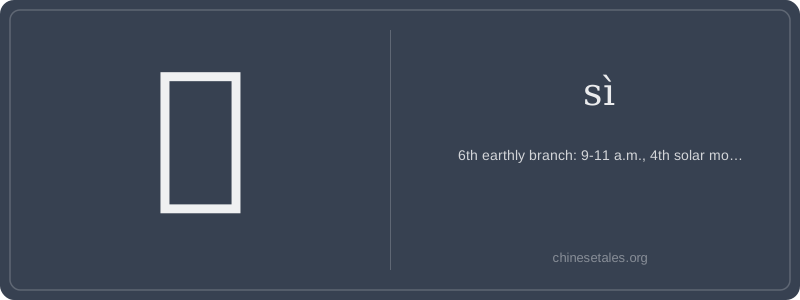
The earliest form of 巳 appears in Shang dynasty oracle bone inscriptions as a sinuous, coiled line — unmistakably a stylized snake, head raised, body looping with elegant tension. Over centuries, the pictograph simplified: the head became a compact curve at the top, the body straightened into two downward strokes, and the tail curled inward to form the distinctive closed loop at the bottom — giving us today’s three-stroke shape: ㇆ (top curve), 丨 (vertical), and 乚 (hooked tail). Though minimalist, every stroke preserves the serpent’s essence: alertness, continuity, and contained power.
By the Zhou dynasty, 巳 had shifted from pure pictograph to symbolic time-marker, anchoring the 6th position in the Earthly Branches system — likely because snakes emerge from hibernation and become most active around late spring, aligning with the 4th solar month. In the Classic of Changes (Yìjīng), 巳 appears in hexagram commentaries tied to ‘rising yang’ and ‘hidden transformation’. Its closed-loop shape — unlike the open forms of 已 or 己 — subtly reinforces its meaning: a self-contained, cyclical moment, not a completed action or personal pronoun. The snake’s wisdom, not its danger, is what 巳 embodies.
巳 (sì) isn’t a character you’ll see on restaurant menus or subway signs — it’s a quiet powerhouse of traditional Chinese timekeeping and cosmology. As the 6th Earthly Branch, it anchors a precise 2-hour window (9–11 a.m.), a solar month (roughly late April–mid-May), and the Snake year in the 12-year zodiac cycle. To Chinese speakers, 巳 evokes rhythm, not grammar: it’s felt in the pulse of ancestral almanacs (黄历), not conjugated verbs. It carries no independent lexical meaning — you won’t ‘use’ it like ‘eat’ or ‘go’ — but it *structures* meaning, like Roman numerals in Western clocks or astrological signs in horoscopes.
Grammatically, 巳 appears almost exclusively in compound terms: never alone, always paired — with Heavenly Stems (e.g., 甲巳), other Earthly Branches (e.g., 巳午未), or zodiac labels (e.g., 巳年). You’ll find it in phrases like ‘巳时’ (sì shí, the hour of the Snake), but never as a standalone verb, noun, or modifier. Learners sometimes try to force it into sentences like ‘I am 巳’ — a classic error, since 巳 isn’t a personal identity marker; it’s a temporal slot, like saying ‘I am 10 a.m.’ in English.
Culturally, 巳 reveals how deeply Chinese thought integrates time, nature, and symbolism. That 9–11 a.m. window? It’s when yang energy peaks before declining — a microcosm of balance central to Daoist and medical philosophy. Mistaking 巳 for similar-looking characters (like 已 or 己) is common — and dangerous in classical texts, where such slips can flip entire interpretations of fate or timing. Its silence in modern daily speech belies its enduring presence in fortune-telling, feng shui, and imperial historiography.