巯
Character Story & Explanation
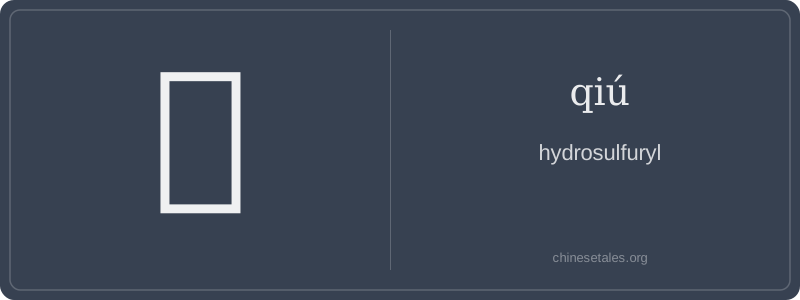
巯 has no oracle bone or bronze script ancestry — it’s a modern coinage, invented in the early 20th century during China’s scientific standardization movement. Its form is deliberately synthetic: top 工 (gōng), suggesting structure and sound; middle 口 (kǒu), reinterpreted not as ‘mouth’ but as a compact, enclosed shape evoking a molecular ring or binding site; bottom 丶 (dot), added to distinguish it from 巩 and signal a terminal functional group. Every stroke was calibrated: 12 strokes total — enough to convey specificity, few enough to write quickly in lab notes. Unlike ancient characters born from observation (like 山 for ‘mountain’), 巯 was designed at a drafting table, not a riverbank.
The character first appeared in the 1932 ‘Chemical Nomenclature Dictionary’ compiled by the National Academy of Sciences, where scholars debated whether to transliterate Western terms or create native equivalents. They chose creation — assigning 巯 to represent the –SH group, leveraging 工’s stable, foundational connotation and the dot’s visual punch to signify reactivity. No classical text mentions it; Confucius never wrote about sulfhydryls. But its very existence reflects a quiet cultural truth: when China modernizes, it doesn’t erase tradition — it recruits it, recalibrating ancient strokes for atomic precision.
Let’s be honest: 巯 (qiú) is a chemical ghost — it floats only in lab notebooks and pharmaceutical patents, not in daily conversation or even most textbooks. Its meaning, 'hydrosulfuryl' (–SH group), reveals how Chinese handles scientific neologisms: by repurposing ancient components with precision. The 工 (gōng) radical isn’t about ‘work’ here — it’s a phonetic scaffold borrowed for its sound (gōng → qiú via historical sound shifts), while the 口 (kǒu) and 丶 (dot) evoke a molecular ‘hook’ or reactive site. This isn’t poetic language; it’s linguistic engineering.
Grammatically, 巯 never stands alone in speech or writing — you’ll only encounter it inside compound terms like 巯基 (qiú jī, 'sulfhydryl group') or 巯醇 (qiú chún, 'thiol'). It never takes aspect particles (了, 过), doesn’t appear in verbs or adjectives, and has zero colloquial usage. Learners mistakenly try to use it like a noun ('the 巯'), but it functions strictly as a bound morpheme — like English ‘-yl’ in ‘hydroxyl’. Its pinyin qiú rhymes with ‘Qiu’ (as in Qiu Xiaolong), not ‘cue’, and tone errors instantly break intelligibility among chemists.
Culturally, 巯 embodies China’s pragmatic approach to scientific literacy: rather than importing loanwords (like English ‘thiol’), it builds new characters using existing radicals — blending tradition with technical rigor. Yet precisely because it’s so rare, learners often misread it as 巩 (gǒng, ‘to consolidate’) or 丐 (gài, ‘beggar’) — both visually similar but worlds apart in meaning and usage. That’s why context is everything: if you see 巯 in a sentence, you’re definitely reading a biochemistry paper — not ordering noodles.