巠
Character Story & Explanation
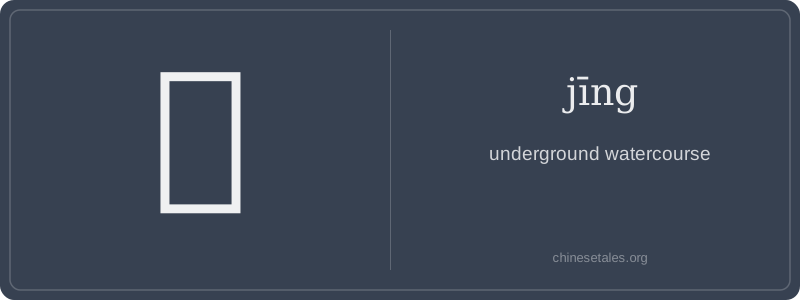
The earliest form of 巠 appears in oracle bone inscriptions as three parallel wavy lines — — mimicking water flowing *between* earthen banks or rock strata. Over centuries, the wavy lines simplified into straight, slightly slanted strokes, while the enclosing ‘banks’ evolved into the radical 巛 (chuān), representing flowing water or terrain contours. By the small seal script era, it had crystallized into its modern shape: two diagonal strokes framing a central vertical stroke flanked by two shorter horizontals — seven strokes total, a compact glyph encoding ‘water confined, channeled, concealed.’
This visual logic directly shaped its meaning: not just ‘water,’ but water *directed*, *contained*, and *hidden* — hence ‘underground watercourse.’ In the Shuōwén Jiězì (121 CE), Xu Shen defines it as ‘shuǐ lù’ (water path), emphasizing directional flow within boundaries. Its semantic power lives on indirectly: in 經 (jīng, ‘classic’), it contributes the idea of ‘a thread running continuously like water through earth’ — thus, a canonical text that flows unbroken through time. The character never surfaced as a common noun, but its ghost guides meaning across millennia.
Picture this: you’re standing at the edge of a dry riverbed in ancient China, and beneath your feet, water whispers through hidden channels — not visible on the surface, but vital, unseen, flowing with quiet purpose. That’s 巠 (jīng): not a river you can see, but an underground watercourse — a subterranean artery of life. It evokes depth, concealment, and natural continuity. Though rare today, it carries a poetic weight — less about utility and more about resonance with hidden forces in classical thought.
Grammatically, 巠 functions almost exclusively as a component in compound characters (like 經 jīng ‘classic’ or 徑 jìng ‘path’) rather than as a standalone word. You’ll almost never see it alone in modern texts — it’s a fossilized root, like ‘-ology’ in English. Learners sometimes misread it as 川 (chuān, ‘river’) or try to use it independently — a classic trap! Its role is etymological, not syntactic: it anchors meaning, not syntax. When you encounter it inside 經, you’re literally seeing ‘the thread of water’ — metaphorically, the unbroken flow of wisdom.
Culturally, 巠 is a silent architect of meaning. In pre-Qin texts, watercourses symbolized cosmic order and moral constancy; underground ones added layers of mystery and foundational truth. Modern learners overlook it because it’s absent from HSK — but that’s precisely why it’s fascinating: it’s the invisible current beneath dozens of high-frequency words. Mistaking it for 川 or 井 (jǐng, ‘well’) misses its unique subterranean nuance — it’s not a source, nor a surface stream, but the hidden conduit itself.