巟
Character Story & Explanation
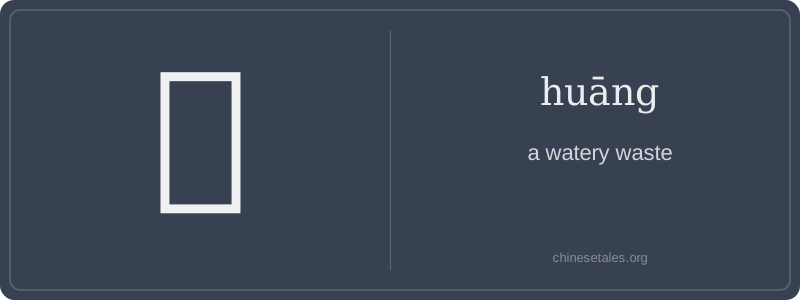
The earliest form of 巟 appears in oracle bone inscriptions as a simple, wavy horizontal line — not unlike a stylized ripple or undulating water surface — with two short, diverging strokes above, suggesting mist rising from a flooded expanse. Over time, in bronze script, those upper strokes became more angular, resembling a simplified 'person' radical (人) turned sideways, though scholars now agree this was coincidental evolution, not semantic intent. By the Small Seal Script era, the character stabilized into its current shape: three horizontal wavy lines (representing layered, boundless water) capped by two diagonal strokes — not a radical, but a fossilized pictorial echo of vapor or horizon haze. There is no true 'radical' — 巟 stands alone, unclassifiable in standard dictionaries.
This visual austerity mirrors its semantic role: 巟 never meant 'river' or 'lake,' but specifically the primordial, unmeasurable water-waste — the chaotic yin before order emerged. In the Chu Ci (Songs of Chu), it appears in phrases like '巟巟之野' (huāng huāng zhī yě), describing the mist-shrouded, waterlogged plains beyond human settlement. Its repetition (巟巟) intensifies the sense of endless, directionless immersion — less 'flooded' and more 'cosmically unmoored.' Even today, when poets use it, they’re not describing geography; they’re invoking a state of metaphysical deluge — the mind’s own uncharted, liquid void.
Think of 巟 (huāng) as Chinese mythology’s version of the primordial ocean in Greek cosmogony — not just 'water,' but the formless, churning, pre-creation abyss where gods haven’t yet drawn boundaries. Its meaning — 'a watery waste' — evokes vast, uninhabitable floodplains or drowned wastelands: desolate, untamed, and eerily still. Unlike common water-related characters like 水 (shuǐ) or 河 (hé), 巟 is never used alone in modern speech; it appears only in literary, poetic, or archaic compounds — like a fossilized word you’d find in a Taoist scroll, not a WeChat message.
Grammatically, 巟 functions exclusively as a morpheme within polysyllabic words (e.g., 荒巟 huāng huāng), never as an independent noun or verb. Learners often mistakenly treat it like 荒 (huāng, 'desolate') — but while 荒 can mean 'barren land' and appears in everyday terms like 荒地 (huāngdì, 'wasteland'), 巟 adds a mythic, aqueous layer: it’s barren *because it’s submerged*, not because it’s dry. You’ll never say 'this field is 巟' — it’s always part of a reduplicated or compound expression that conjures atmosphere, not description.
Culturally, 巟 carries Daoist and early cosmological weight: it echoes the 'chaotic waters' before Heaven and Earth separated (as in the Huainanzi). Mistake it for 荒 or 慌 (huāng, 'panic'), and you’ll accidentally swap existential desolation for aquatic chaos — or worse, imply your colleague is drowning in anxiety! Its near-total absence from spoken Mandarin means encountering it feels like unearthing a linguistic relic: beautiful, precise, and utterly impractical for ordering dumplings.