巅
Character Story & Explanation
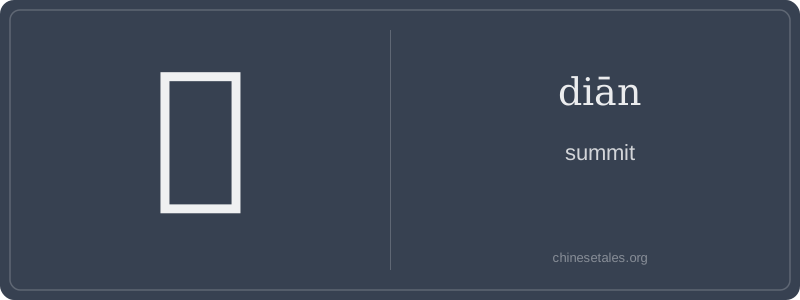
The earliest form of 巅 appears in bronze inscriptions as a stylized mountain (山) topped by a simplified head (页, yè, originally meaning 'forehead' or 'face') — not a person standing, but the mountain’s own 'crown'. Over centuries, the head evolved into 页 (a character that itself meant 'page' or 'leaf' but carried connotations of surface/face), while the mountain radical 山 stayed anchored below. By the Han dynasty, the lower part transformed further: the original 'legs' beneath 页 became two distinct 'feet' (⻊), symbolizing the climber’s final, grounded stance atop the peak — a brilliant fusion of landscape and human presence.
This visual logic deepened in classical literature: in Du Fu’s poems, 巅 isn’t just height — it’s isolation, clarity, and moral elevation ('I stand alone on the 巅, wind tearing my sleeves'). The dual 'feet' weren’t decorative; they signaled arrival, conquest, and stillness after ascent. Even today, the 19 strokes feel deliberate — each one a step upward, culminating in those twin feet that root the word in tangible, human triumph rather than abstract altitude.
Think of 巅 (diān) as China’s Mount Everest — not just a mountain top, but the *absolute apex*, the point where breath catches and perspective flips. Unlike English 'summit', which can be used metaphorically ('summit meeting'), 巅 carries a weighty, almost sacred solemnity: it’s reserved for physical peaks (Qomolangma’s 巅), poetic extremes ('the 巅 of human emotion'), or rare, elevated abstractions ('the 巵 of classical scholarship'). You’ll almost never hear it in casual speech — it’s literary, formal, and deeply visual.
Grammatically, 巅 functions as a noun only — never a verb or adjective — and nearly always appears with modifiers: 雪巅 (xuě diān, snow-capped summit), 云巅 (yún diān, cloud-wrapped peak), or the fixed phrase 巅峰 (diān fēng, pinnacle). Learners mistakenly try to use it like 顶 (dǐng, 'top') — but while you can say 房顶 (fáng dǐng, roof top), saying 房巅 is nonsensical. 巅 demands grandeur: mountains, ambition, mastery, or cosmic scale.
Culturally, 巅 evokes Daoist transcendence and Tang poetry’s vertical yearning — Li Bai didn’t just climb a mountain; he sought the 巅 to commune with immortals. Modern usage often appears in political or motivational rhetoric ('reaching the 巅 of national rejuvenation'), making it a subtle barometer of tone: if you see 巅, brace for gravity, not small talk. A common error? Writing it as 巅 instead of the correct form — its 19 strokes include two tricky 'feet' (⻊) at the bottom, not one.